B.Tech: Full Form, Duration, Subjects, Eligibility, Admission 2027
February 25, 2026 2026-11-02 7:00B.Tech: Full Form, Duration, Subjects, Eligibility, Admission 2027
B.Tech: Full Form, Duration, Subjects, Eligibility, Admission 2027
At Desh Bhagat University, we understand that choosing the right professional course is one of the most important decisions in your life. B.Tech is one of the most popular and respected professional degrees in India. In this article, we will explain what B.Tech means what the B.Tech courses are, the B.Tech full form, eligibility rules, course duration, syllabus, subjects, and the best options for you after B.Tech.
We have written this guide in simple terms so that you can easily understand every detail about B.Tech and make a confident decision about your future.
What is B.Tech?
The B.Tech full form is “Bachelor of Technology.” It is an undergraduate professional degree in the field of engineering and technology. Through this degree, students learn the science and technology behind machines, software, structures, electronics, and systems that we use every day.
At Desh Bhagat University, we offer a strong B.Tech courses with a focus on real learning and industry-ready skills. Our aim is to help students not only get a degree but also become competent professionals.
Why Choose B.Tech?
Choosing B.Tech means you are choosing a career that is full of opportunities. B.Tech builds your problem-solving skills, technical knowledge, and prepares you for jobs in engineering, research, data science, civil projects, IT services, and many more.
This degree also opens doors for higher studies and specialisations, such as M.Tech (Master of Technology), MBA (Master of Business Administration), or professional certifications. At Desh Bhagat University, we help you grow in every step of your journey.
B.Tech Eligibility
Before applying, it is important to understand the B.Tech Eligibility Criteria. At Desh Bhagat University, the basic eligibility criteria are:
✔ You must have passed 10+2 or equivalent from a recognised board.
✔ Your subjects must include Physics, Mathematics, and one other science subject such as Chemistry, Biology, or Computer Science.
✔ Minimum marks, as per the university rules, must be achieved in your qualifying exam.
This eligibility ensures that you have the necessary foundation in science and mathematics to begin your engineering journey.
B.Tech Courses Offered
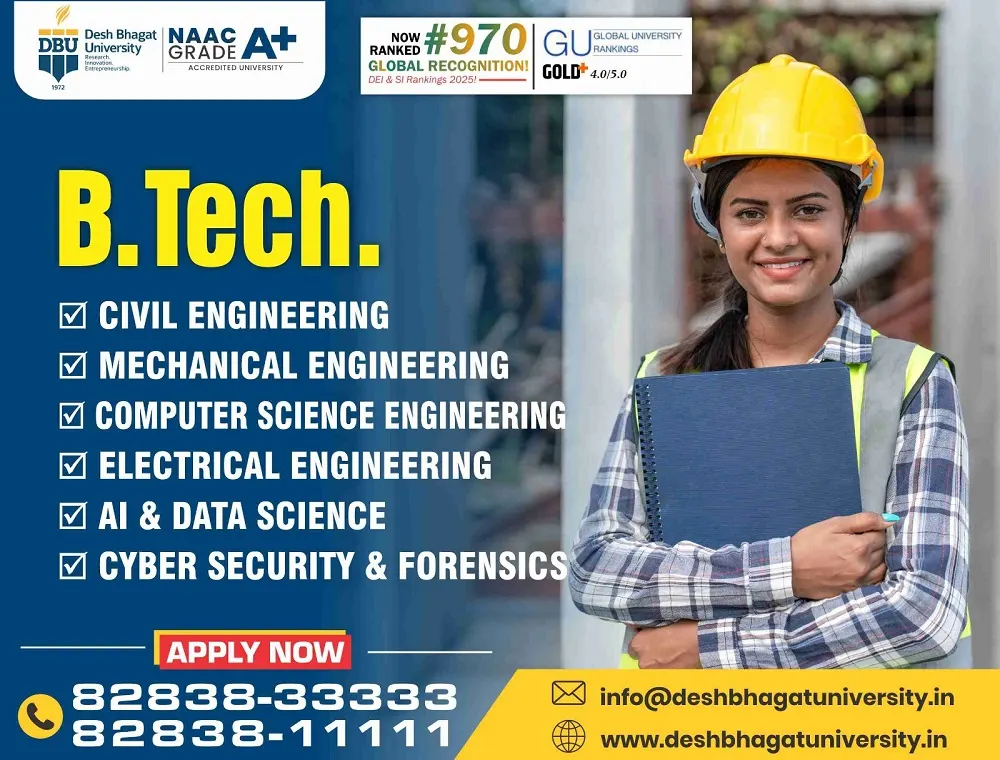
At Desh Bhagat University, we offer a variety of B.Tech courses to match your interests in technology and engineering. Some of the most popular B.Tech specialisations include:
- B. Tech (Civil Engineering)
- B. Tech (Mechanical Engg.)
- B. Tech (Computer Science Engineering)
- B. Tech (Electrical Engineering)
- B. Tech (Artificial Intelligence and Data Sciences)
- B. Tech (Cyber Security and Forensics)
These courses are designed to give you both theoretical knowledge and practical skills. You will learn in modern labs, attend workshops, and take part in industry projects that prepare you for real work challenges.
B.Tech Course Duration
The B.Tech course duration is four years. This time is divided into eight semesters. In each semester, you will study different subjects that build up your knowledge layer by layer.
In your first year, you will learn basic science and engineering subjects. As you move ahead, you will study more specialised topics related to your chosen branch.
By the final year, you will participate in practical projects, internships, and hands-on work that help you learn by doing.
B.Tech Syllabus and Subjects
The B.Tech syllabus covers fundamental engineering concepts, scientific principles, programming, and practical applications. During the first year, students study common engineering subjects. In later years, the curriculum focuses on subjects related to their chosen specialisation.
Common Subjects in B.Tech
The following subjects help students develop a strong foundation in science, mathematics, and engineering principles.
| Subject | Key Topics Covered |
|---|---|
| Mathematics | Calculus, algebra, differential equations, and engineering mathematics |
| Physics | Mechanics, electricity, magnetism, and applied physics |
| Chemistry | Chemical reactions, engineering materials, and applied chemistry |
| Basic Electrical Engineering | Electrical circuits, current, voltage, and electrical systems |
| Basic Computer Programming | Programming fundamentals, logic building, and problem-solving |
| Engineering Graphics | Technical drawing, engineering design, and graphical representation |
Branch-Specific B.Tech Subjects
After completing the common foundational subjects, students study specialised subjects based on their selected engineering branch.
1. Computer Science and Engineering (CSE)
| Subject | Key Learning Areas |
|---|---|
| Data Structures and Algorithms | Data organisation, algorithms, and problem-solving |
| Operating Systems | Process management, memory, and system operations |
| Database Systems | Database design, storage, and management |
| Software Engineering | Software development, testing, and maintenance |
| Computer Networks | Network communication and data transmission |
2. Mechanical Engineering
| Subject | Key Learning Areas |
|---|---|
| Thermodynamics | Heat, energy, and thermodynamic processes |
| Strength of Materials | Stress, strain, and material behaviour |
| Machine Design | Machine components and mechanical design |
| Fluid Mechanics | Fluid behaviour, flow, and pressure |
| Manufacturing Technology | Manufacturing processes and production methods |
3. Electrical Engineering
| Subject | Key Learning Areas |
|---|---|
| Circuit Theory | Electrical circuits and network analysis |
| Power Systems | Electricity generation, transmission, and distribution |
| Electrical Machines | Motors, generators, and transformers |
| Control Systems | System modelling and automatic control |
| Electrical Measurements | Electrical instruments and measurement techniques |
4. Civil Engineering
| Subject | Key Learning Areas |
|---|---|
| Structural Analysis | Structural behaviour, forces, and load distribution |
| Construction Materials | Properties and applications of construction materials |
| Surveying | Land measurement and mapping techniques |
| Concrete Technology | Concrete properties, testing, and applications |
| Geotechnical Engineering | Soil properties and foundation engineering |
5. Artificial Intelligence and Data Sciences
| Subject | Key Learning Areas |
|---|---|
| Fundamentals of Artificial Intelligence | AI concepts and intelligent systems |
| Data Structures and Python Programming | Python coding and data organisation |
| Machine Learning | Algorithms, predictive models, and data training |
| Data Analytics and Visualization | Data interpretation and visual representation |
| Big Data Technologies | Large-scale data processing and management |
| Deep Learning Basics | Neural networks and deep learning concepts |
6. Cyber Security and Forensics
| Subject | Key Learning Areas |
|---|---|
| Cyber Security Fundamentals | Security principles, cyber threats, and vulnerabilities |
| Network Security | Network protection and attack prevention |
| Ethical Hacking | Vulnerability assessment and security testing |
| Digital Forensics | Digital evidence collection and cybercrime investigation |
| Cryptography | Data encryption and decryption |
| Information Security Management | Security policies, risk assessment, and information protection |
Each B.Tech specialisation combines theoretical knowledge with practical learning to help students develop engineering skills, technical expertise, and problem-solving abilities.
Note: The subjects listed are indicative examples based on the information provided. Actual subjects and semester-wise allocation may vary by specialisation and the approved university curriculum.
Practical Learning in B.Tech
Studying engineering theory is important, but practical learning is even more exciting. In our B.Tech course, we focus on hands-on education. You will:
- Work in modern laboratories
- Use real machines and tools
- Take part in industrial training
- Complete projects and assignments
This practical approach makes sure that you do not just read theory, but also know how to apply it in real life.
Internships and Industry Exposure
During the B.Tech course, students also get opportunities for internships with companies. These internships are very helpful because:
- You learn how companies work.
- You understand practical engineering tasks.
- You gain skills that help you get a job easily.
At Desh Bhagat University, we help students find internships and connect with industries, so that you are ready for your career ahead.
Career Opportunities after B.Tech
After completing your B.Tech degree, many exciting career options await you. Some of the top jobs you can consider are:
✔ Software Developer
✔ Civil Engineer
✔ Mechanical Engineer
✔ Electrical Engineer
✔ Quality Engineer
✔ Network Administrator
Apart from these jobs, you can also choose to work in government sectors, private firms, research labs, or even start your own technology-based business.
After B.Tech, Which Course is Best?
Many students ask: “After B.Tech, which course is best?” The answer depends on your interests and goals. Some popular options after B.Tech are:
1. M.Tech (Master of Technology)
This is a good choice if you want to specialise deeply in your engineering field.
2. MBA (Master of Business Administration)
If you are interested in management, leadership, and business skills, an MBA helps you grow into managerial roles.
3. Professional Certifications
Courses like Cloud Computing, AI, Data Science, Cyber Security, Robotics, and Project Management are great for enhancing your skills.
4. GATE & Competitive Exams
Some students prepare for exams like GATE, UPSC, or PSC exams to get jobs in public sector companies or higher studies.
At Desh Bhagat University, we offer career guidance and support to help you choose the best path after B.Tech.
Why B.Tech is a Good Choice for You
Choosing B.Tech means choosing a future full of possibilities. It gives you:
- Strong technical knowledge
- Job opportunities in many industries
- Skills that are in high demand
- A chance to build new and useful technology
Most importantly, B.Tech teaches you how to think, create, and solve problems — skills that are useful in every part of life.
At Desh Bhagat University, we want every student to grow, succeed, and achieve their dreams.
How to Apply for B.Tech at Desh Bhagat University
Students can follow these simple steps to apply for B.Tech admission at Desh Bhagat University. Our admission team provides guidance throughout the application and admission process.
| Step | Admission Process | Details |
|---|---|---|
| 1 | Visit the Admission Portal | Open the DBU Online Admission Portal. |
| 2 | Fill Out the Application Form | Enter your personal information and academic details correctly. |
| 3 | Upload Documents | Upload the required educational certificates and supporting documents. |
| 4 | Submit Application | Review your information and submit the completed application form. |
| 5 | Counselling and Guidance | Our admission team will contact you to guide you through the next steps. |
| 6 | Fee Payment and Confirmation | Complete the applicable fee payment and admission formalities to confirm your seat. |
Our admission team is available to assist students throughout the process and help them take the next step towards their engineering education.
Conclusion
B.Tech is a powerful and practical degree that can shape your future in engineering and technology. From the B.Tech full form to eligibility, course duration, subjects, syllabus, and career choices after B.Tech, we have covered everything you need to know.
At Desh Bhagat University, we offer excellent B.Tech courses with a focus on learning, practical experience, and real career growth. Whether you want to become a software engineer, mechanical expert, or tech leader, B.Tech can take you there.
If you are ready to start your engineering journey, we are here to guide you every step of the way.
Welcome to Desh Bhagat University — where your dreams take flight!
FAQs
B.Tech means Bachelor of Technology. It is a four-year undergraduate degree in engineering and technology. In this course, students learn how machines, computers, software, and systems work. At Desh Bhagat University, we teach B.Tech with both theory and practical training. This helps students become skilled engineers who can solve real-life problems and work in different industries.
The B.Tech full form is Bachelor of Technology. It is a professional engineering degree offered by many universities in India. This course focuses on science, mathematics, and technology. Students learn technical skills, computer knowledge, and engineering concepts. After completing this degree, students can work in private companies, government sectors, or continue higher studies.
Students who have passed 10+2 with Physics, Mathematics, and science subjects can apply for B.Tech admission. They must have studied from a recognised board. Minimum marks are required as per university rules. Students who are interested in technology, machines, computers, and innovation are suitable for this course. Before applying, students should check eligibility rules carefully.
The B.Tech course duration is four years. These four years are divided into eight semesters. Each semester has different subjects and practical sessions. In the first year, students learn basic science and engineering. In later years, they study advanced subjects of their chosen branch. This long duration helps students gain deep technical knowledge and experience.
There are many B.Tech courses available, such as Civil Engineering, Mechanical Engineering, Computer Science Engineering, Electrical Engineering, Artificial Intelligence and Data Sciences, and Cyber Security and Forensics. Each course focuses on a different area of technology. Students should choose their branch based on their interests and career goals. All branches offer good job opportunities when studied seriously.
The B.Tech syllabus includes theory subjects, practical lab work, projects, and internships. Students study mathematics, physics, computer programming, and engineering basics in the first year. Later, they learn specialised subjects of their branch. The syllabus is designed to build technical skills, problem-solving ability, and professional knowledge step by step.
The B.Tech subjects depend on the chosen branch. Common subjects include Mathematics, Physics, Programming, and Engineering Basics. Computer students study software and coding subjects. Mechanical students study machines and design. Civil students study construction and structures. Electrical students study circuits and power systems. These subjects help students become strong engineers.
Yes, practical training is very important in B.Tech. Students work in laboratories, workshops, and on real projects. They also do internships in companies. This helps them understand how engineering works in real life. Practical learning builds confidence and improves job skills. It also helps students perform better in interviews and professional work.
After B.Tech, students can work as engineers, developers, designers, or technical experts. They can join IT companies, manufacturing firms, construction companies, or government departments. Some students also start their own businesses. Others prepare for higher studies or competitive exams. B.Tech offers many career paths depending on skills and interests.
Many students ask, after B.Tech which course is best. The answer depends on your career goals and interests. For higher technical knowledge, M.Tech is a good option. If you want management jobs, MBA is a popular choice. Professional courses in Data Science, AI, Cloud Computing, and Cyber Security are also helpful. Some students also prepare for government exams. Choosing the right course plays an important role in career growth.