B.Tech Mechanical Engineering: Course Details & Admission 2027
December 13, 2025 2026-11-04 6:28B.Tech Mechanical Engineering: Course Details & Admission 2027
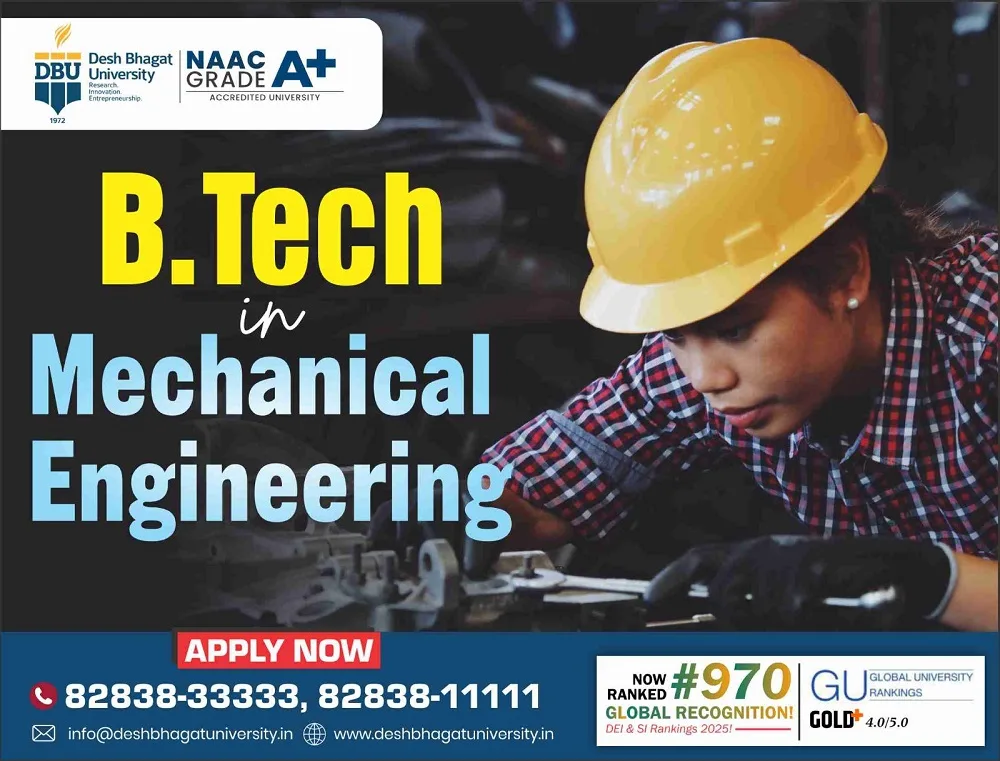
B.Tech Mechanical Engineering: Course Details & Admission 2027
Choosing the right engineering course is an important step towards building a professional career. Mechanical Engineering is one of the major branches of engineering. It focuses on the design, development, manufacturing, operation, and maintenance of machines and mechanical systems.
At Desh Bhagat University, we offer B.Tech Mechanical Engineering for students who want to develop their technical knowledge and understand how machines, tools, engines, and industrial systems work. Our programme introduces students to important areas of mechanical engineering, including thermodynamics, fluid mechanics, material science, manufacturing technology, and machine design.
The B.Tech Mechanical Engineering programme helps students build a foundation in engineering principles and understand their practical applications. Students can develop the knowledge and skills required to explore career opportunities in manufacturing, automobiles, production, design, maintenance, research, and other engineering fields.
In this article, we explain the B.Tech Mechanical Engineering course details, eligibility, duration, syllabus, important subjects, admission process, career opportunities, and salary prospects.
B.Tech Mechanical Engineering
Programme Overview – Desh Bhagat University, Mandi Gobindgarh, Punjab
| Course Details | Information |
|---|---|
| Course Name | Bachelor of Technology in Mechanical Engineering |
| Short Name | B.Tech Mechanical Engineering |
| Course Level | Undergraduate |
| Course Duration | 4 Years |
| Total Semesters | 8 Semesters |
| Direct Entry Eligibility | 10+2 with Physics and Mathematics as compulsory subjects and one relevant subject |
| Lateral Entry | 3 Years |
| Lateral Entry Qualification | Relevant Diploma in Engineering |
| Main Study Areas | Thermodynamics, Fluid Mechanics, Manufacturing and Machine Design |
| Course Type | Engineering and Technology |
| Career Areas | Manufacturing, Automobile, Production, Design and Maintenance |
| University | Desh Bhagat University |
| Location | Mandi Gobindgarh, Punjab |
What Is B.Tech Mechanical Engineering?
B.Tech Mechanical Engineering is an undergraduate engineering degree that teaches students how to design, develop, manufacture, operate, and maintain mechanical systems.
Mechanical engineering combines principles of physics, mathematics, materials science, and engineering technology. It is used in many industries, including automobile manufacturing, aviation, energy production, industrial equipment, robotics and manufacturing.
During the programme, students learn about the working principles of machines, engines, mechanical components and industrial processes. They also study how engineering designs are developed, tested and improved.
For example, mechanical engineers may work on designing vehicle components, improving manufacturing processes, developing energy systems, testing machine performance and maintaining industrial equipment.
Why Choose DBU for B.Tech Mechanical Engineering?
At Desh Bhagat University, our Department of Mechanical Engineering focuses on developing students’ understanding of engineering principles, technical concepts and their applications. The following table highlights the key learning areas of our B.Tech Mechanical Engineering programme.
| Key Learning Areas | Details |
|---|---|
| Mechanical Engineering Fundamentals | Understand important engineering principles related to the design, operation and maintenance of mechanical systems. |
| Manufacturing and Production | Learn about manufacturing methods, production processes and engineering principles used in making mechanical products. |
| Machine Design | Develop knowledge of mechanical components, their functions, material selection and design considerations. |
| Materials and Mechanics | Study engineering materials, their properties, strength and behaviour under different forces. |
| Thermal Engineering | Understand heat, energy, thermodynamics and their applications in engines and mechanical systems. |
| Problem-Solving Skills | Develop logical thinking, technical understanding and problem-solving abilities required in engineering careers. |
B.Tech Mechanical Engineering Course Highlights
The B.Tech Mechanical Engineering programme covers different areas of mechanical engineering, from basic scientific principles to specialised engineering applications.
| Course Highlights | Details |
| Engineering Fundamentals | Mathematics, Physics and Engineering Mechanics |
| Thermal Engineering | Thermodynamics and Heat Transfer |
| Fluid Engineering | Fluid Mechanics and Fluid Dynamics |
| Material Studies | Engineering Materials and Material Science |
| Manufacturing | Manufacturing Processes and Production Technology |
| Machine Design | Mechanical Components and Design Principles |
| Industrial Applications | Production, Maintenance and Industrial Engineering |
| Career Development | Technical Knowledge and Engineering Problem-Solving |
These areas provide a broad introduction to the mechanical engineering field.
Eligibility for B.Tech Mechanical Engineering
Students seeking admission to B.Tech Mechanical Engineering at Desh Bhagat University must meet the applicable academic eligibility requirements. We offer two admission routes: Direct Entry and Lateral Entry.
B.Tech Mechanical Engineering Eligibility Criteria
| Admission Route | Required Qualification | Minimum Marks | Course Duration |
|---|---|---|---|
| Direct Entry | 10+2 from a recognised board with Physics, Mathematics and one relevant subject (Chemistry, Biotechnology, Computer Science or Biology). | 45% | 4 Years |
| Lateral Entry | Diploma in Engineering from a recognised State Board of Technical Education. | 45% | 3 Years |
Additional Eligibility Information:
- A 5% relaxation in minimum marks is available for eligible SC/ST candidates and rural and underprivileged candidates, subject to university rules.
- Direct Entry applicants must have studied Physics and Mathematics as compulsory subjects.
- Lateral Entry applicants must hold a relevant Engineering Diploma.
Students can contact our admission team to confirm their eligibility and applicable admission requirements before applying.
Admission Process
At Desh Bhagat University, we follow an admission process to help students apply for their preferred engineering programme.
Students interested in B.Tech Mechanical Engineering can follow these general steps:
| Step | Admission Process | Description |
| Step 1 | Explore the Programme | Review the course details, duration, eligibility and subjects. |
| Step 2 | Check Eligibility | Confirm that you meet the academic requirements. |
| Step 3 | Register Online | Visit our official admission portal and complete registration. |
| Step 4 | Fill in the Application | Enter your personal and academic details correctly. |
| Step 5 | Upload Documents | Submit the required academic and personal documents. |
| Step 6 | Complete the Application | Pay the applicable application fee and submit the form. |
| Step 7 | Admission Confirmation | Follow the university’s instructions regarding admission and document verification. |
B.Tech Mechanical Engineering Course Duration
The B.Tech Mechanical Engineering course duration at Desh Bhagat University is four years for students applying through Direct Entry.
The programme is divided into eight semesters. Each semester covers different engineering subjects and helps students build their knowledge step by step.
Students applying through Lateral Entry can complete the programme in three years, subject to the applicable admission and academic rules.
| Entry Type | Course Duration | Total Semesters |
| Direct Entry | 4 Years | 8 Semesters |
| Lateral Entry | 3 Years | 6 Semesters |
During the programme, students progress from basic engineering concepts to specialised mechanical engineering subjects.
B.Tech Mechanical Engineering Syllabus
The B.Tech Mechanical Engineering syllabus covers the basic and advanced concepts required to understand mechanical systems and industrial applications.
The programme introduces students to engineering mathematics, mechanics, materials, thermodynamics, manufacturing, machine design, and other important areas.
The following table provides a broad overview of the subjects generally covered during the different stages of mechanical engineering education. Actual semester-wise subjects are based on the university’s approved curriculum.
First Year: Engineering Fundamentals
The first year focuses on building a foundation in science, mathematics, and basic engineering.
| Subject Area | What Students Learn |
| Engineering Mathematics | Mathematical concepts used in engineering calculations |
| Engineering Physics | Basic principles of physics and their engineering applications |
| Engineering Chemistry | Chemical properties of materials and their uses |
| Engineering Mechanics | Forces, motion and equilibrium of mechanical systems |
| Engineering Graphics | Technical drawings and engineering design representation |
| Basic Electrical Engineering | Basic electrical principles and circuits |
| Communication Skills | Technical communication and professional writing |
Second Year: Core Mechanical Engineering
The second year introduces students to important mechanical engineering concepts.
| Subject Area | What Students Learn |
| Thermodynamics | Heat, work, energy and their applications |
| Fluid Mechanics | Behaviour and movement of liquids and gases |
| Strength of Materials | Strength, stress and deformation of materials |
| Material Science | Properties and selection of engineering materials |
| Manufacturing Processes | Methods used to manufacture mechanical components |
| Engineering Mechanics | Motion and forces in mechanical systems |
Third Year: Advanced Mechanical Engineering
The third year focuses on specialised engineering subjects and their industrial applications.
| Subject Area | What Students Learn |
| Machine Design | Design and analysis of machine components |
| Heat Transfer | Transfer of heat through different materials and systems |
| Fluid Machinery | Working principles of pumps, turbines and related equipment |
| Manufacturing Technology | Advanced manufacturing methods and processes |
| Theory of Machines | Motion and working of mechanical systems |
| Industrial Engineering | Production planning and industrial operations |
Fourth Year: Advanced Applications and Projects
The final year focuses on applying engineering knowledge to more advanced problems and practical applications.
| Subject Area | What Students Learn |
| Mechanical Design | Design and analysis of mechanical systems |
| Thermal Engineering | Applications of heat and energy systems |
| Maintenance Engineering | Maintenance and reliability of mechanical equipment |
| Production Management | Planning and management of production activities |
| Project Work | Application of engineering concepts to a selected project |
| Technical Electives | Specialised topics based on the approved curriculum |
Note: This is an indicative subject-area overview, not a substitute for the approved semester-wise syllabus. Students should refer to the current university curriculum for exact subject names and semester allocation.
Important Subjects in B.Tech Mechanical Engineering
B.Tech Mechanical Engineering covers various subjects that help students understand machines, mechanical systems, manufacturing processes and industrial applications.
The following table highlights some important subjects included in Mechanical Engineering:
| Subject Name | Description |
|---|---|
| Engineering Mechanics | Covers forces, motion and the behaviour of physical systems. It provides a foundation for understanding advanced engineering concepts. |
| Thermodynamics | Explains heat, energy, temperature and work, including their applications in engines, power plants and refrigeration systems. |
| Fluid Mechanics | Introduces the properties and movement of liquids and gases, including fluid pressure, flow and velocity. |
| Strength of Materials | Explains stress, strain, bending, torsion and material strength under different loading conditions. |
| Manufacturing Technology | Covers manufacturing processes such as machining, casting, welding and forming. |
| Machine Design | Focuses on mechanical components, material selection, mechanical strength and design principles. |
| Heat and Mass Transfer | Explains heat transfer through conduction, convection and radiation, along with its engineering applications. |
| Industrial Engineering | Covers production processes, resource utilisation, workflow management and operational efficiency. |
Practical Applications of Mechanical Engineering
Mechanical Engineering is used in many products, machines and industrial systems that are part of everyday life.
At Desh Bhagat University, we aim to help students understand the connection between engineering concepts and their practical applications.
Some important application areas include:
| Application Area | Role of Mechanical Engineering |
| Automobile Industry | Development and improvement of vehicle components and systems |
| Manufacturing | Design and production of machines and industrial products |
| Aerospace | Engineering of mechanical systems used in aircraft |
| Energy | Development and operation of thermal and energy systems |
| Robotics | Design and development of mechanical parts used in robotic systems |
| Industrial Equipment | Design, operation and maintenance of machinery |
| Medical Equipment | Development of mechanical components used in medical devices |
| Environmental Systems | Mechanical systems used in ventilation, cooling and energy management |
These applications show how mechanical engineering contributes to different industries.
Skills Developed During B.Tech Mechanical Engineering
Mechanical engineering requires a combination of technical knowledge, analytical thinking and problem-solving abilities.
During the programme, students can develop several skills that are useful for professional engineering work.
| Skill | Importance |
| Technical Knowledge | Helps understand mechanical systems and engineering principles |
| Problem-Solving | Supports the identification and solution of engineering problems |
| Analytical Thinking | Helps evaluate technical information and engineering designs |
| Design Understanding | Supports the development of mechanical components and systems |
| Material Knowledge | Helps in selecting suitable materials for engineering applications |
| Teamwork | Supports collaboration on engineering tasks and projects |
| Communication | Helps explain technical information clearly |
| Time Management | Supports the planning and completion of engineering work |
These skills can help graduates prepare for different responsibilities in the engineering sector.
Career Opportunities After B.Tech Mechanical Engineering
B.Tech Mechanical Engineering graduates can explore career opportunities in manufacturing, automobile production, industrial equipment, energy systems, product development, quality control, and maintenance.
The following tables highlight common job roles and industries for Mechanical Engineering graduates.
Popular Job Roles After B.Tech Mechanical Engineering
| Job Role | Key Responsibilities |
|---|---|
| Mechanical Engineer | Works on the design, operation, and maintenance of mechanical systems. |
| Design Engineer | Develops and evaluates designs for mechanical components and products. |
| Production Engineer | Supports manufacturing activities and production processes. |
| Manufacturing Engineer | Improves manufacturing methods and production efficiency. |
| Quality Engineer | Checks product quality and maintains engineering standards. |
| Maintenance Engineer | Handles the inspection, repair and maintenance of machinery. |
| Automotive Engineer | Works on vehicle systems, components and related engineering activities. |
| Research and Development Engineer | Studies technical problems and supports new product development. |
| Project Engineer | Coordinates engineering tasks, project activities and technical requirements. |
| Technical Sales Engineer | Provides technical product information and engineering support to customers. |
Industries Hiring Mechanical Engineering Graduates
| Industry | Career Opportunities |
|---|---|
| Automobile Industry | Vehicle design, component development, production, and quality control. |
| Manufacturing Industry | Production management, machinery operations, manufacturing processes and product quality. |
| Aerospace Industry | Aircraft components, mechanical systems and manufacturing processes. |
| Energy Sector | Energy systems, thermal equipment and power generation. |
| Industrial Equipment | Machinery design, equipment maintenance, testing and operation. |
| Research and Development | Technical research, product development, engineering analysis and innovation. |
B.Tech Mechanical Engineering Salary in India
The salary after B.Tech Mechanical Engineering in India depends on job role, technical skills, work experience, industry, company and employment location.
Fresh graduates generally begin their careers in entry-level engineering positions. With experience and specialised technical knowledge, they can explore higher-level positions and better earning opportunities.
Average Salary in India
The following table provides indicative annual salary ranges for different mechanical engineering job roles in India.
| Job Role | Average Annual Salary |
| Graduate Engineer Trainee | ₹2.5–4 LPA |
| Junior Mechanical Engineer | ₹2.5–4.5 LPA |
| Design Engineer | ₹3–6 LPA |
| Production Engineer | ₹3–5 LPA |
| Manufacturing Engineer | ₹3–6 LPA |
| Quality Engineer | ₹2.5–5 LPA |
| Maintenance Engineer | ₹2.5–5 LPA |
| Automotive Engineer | ₹3–6 LPA |
| Project Engineer | ₹3.5–7 LPA |
| Research and Development Engineer | ₹3.5–7 LPA |
Note: These are indicative industry estimates, not guaranteed salary packages or DBU placement figures. Actual salaries vary by employer, location, skills and experience.
Factors Affecting Mechanical Engineering Salary
| Factor | How It Affects Salary |
| Educational Qualification | Additional qualifications may support career growth. |
| Technical Skills | Knowledge of CAD, CAM, automation and engineering tools can improve job prospects. |
| Work Experience | Experienced professionals may qualify for higher-level responsibilities. |
| Job Role | Salary varies between design, production, quality and maintenance roles. |
| Industry | Different industries may offer different compensation packages. |
| Location | Salary levels may vary depending on the employment location. |
| Company | Employer size, business type and job requirements can affect compensation. |
Career Growth in Mechanical Engineering
| Career Stage | Possible Job Roles | Indicative Annual Salary |
| Entry Level | Graduate Engineer Trainee, Junior Mechanical Engineer | ₹2.5–4.5 LPA |
| Early Career | Design Engineer, Production Engineer, Quality Engineer | ₹3–6 LPA |
| Experienced Professional | Senior Mechanical Engineer, Project Engineer, Manufacturing Specialist | ₹5–9 LPA |
| Advanced Career | Engineering Manager, Project Manager, Technical Consultant | ₹8–15+ LPA |
Salary ranges are indicative estimates for the Indian job market and are not university placement commitments.
How to Improve Salary After B.Tech Mechanical Engineering
Mechanical engineering graduates can improve their career opportunities by developing relevant technical skills and gaining professional experience.
Some useful skills include:
- AutoCAD: Used for engineering drawings and design.
- SolidWorks: Used for 3D modelling and mechanical product design.
- CATIA: Used in product design and automobile engineering.
- ANSYS: Used for engineering simulation and analysis.
- CNC Programming: Useful in manufacturing and production.
- Automation and Robotics: Relevant to modern industrial systems.
There is no fixed salary for all B.Tech Mechanical Engineering graduates. Actual compensation depends on the employer, job responsibilities, technical skills and professional experience.
Higher Studies After B.Tech Mechanical Engineering
After completing B.Tech Mechanical Engineering, graduates can pursue postgraduate education, research opportunities or specialised technical courses to develop advanced knowledge.
| Higher Education Options | Details |
| M.Tech in Mechanical Engineering | A postgraduate programme for students interested in advanced mechanical engineering concepts. At Desh Bhagat University, students can explore M.Tech in Mechanical Engineering with a specialisation in Machine Design. |
| MBA | Suitable for engineering graduates interested in business management, operations, finance, marketing and leadership. |
| Research and Development | Students can explore research opportunities in robotics, manufacturing, energy systems, materials and mechanical design. |
| CAD (Computer-Aided Design) | Develop skills in computer-based mechanical design, drafting and modelling. |
| CAM (Computer-Aided Manufacturing) | Learn about computer-controlled manufacturing processes and production techniques. |
| CAE (Computer-Aided Engineering) | Explore engineering simulation, product analysis and design testing. |
| Robotics and Automation | Develop technical knowledge of robotic systems, automated processes and industrial applications. |
| Industrial Automation | Explore automation technologies used in industrial production and manufacturing. |
| Advanced Manufacturing | Study modern manufacturing methods, production technologies and process improvement. |
| Product Design | Develop knowledge of product development, mechanical design and engineering solutions. |
The choice of higher studies depends on students’ academic interests, career goals and preferred areas of specialisation.
Why Study at Desh Bhagat University?
At Desh Bhagat University, we offer multidisciplinary education across various academic areas, including engineering and technology. Our Department of Mechanical Engineering focuses on developing students’ understanding of important engineering concepts and their applications.
The following table highlights some important reasons to consider studying Mechanical Engineering at our university.
| Key Features | Details |
| Mechanical Engineering Department | Our Department of Mechanical Engineering offers academic programmes at different levels to support students interested in this engineering field. |
| Multiple Engineering Study Areas | Students can explore different engineering disciplines and understand the role of technology in modern industries. |
| Engineering Fundamentals | Our academic focus includes materials, solid mechanics, fluid mechanics, thermodynamics, fluid dynamics, energy and heat transfer. |
| Practical Engineering Orientation | Practical laboratories and engineering workshops support students in understanding engineering concepts and their applications. |
| Multidisciplinary Academic Environment | We offer programmes across different academic fields, allowing students to study in a broad educational environment. |
| Career Development Opportunities | We encourage students to develop technical knowledge, professional skills, teamwork and problem-solving abilities for their future careers. |
What to Do After B.Tech Mechanical Engineering?
After completing B.Tech Mechanical Engineering, students can choose different career and education pathways based on their interests.
| Option | Description |
| Start a Job | Explore opportunities in design, manufacturing, production and maintenance. |
| Pursue M.Tech | Develop advanced knowledge in mechanical engineering. |
| Pursue MBA | Explore management and business-related career opportunities. |
| Enter Research | Work towards technical research and engineering development. |
| Learn Specialised Skills | Develop additional knowledge in CAD, CAM, automation or related areas. |
| Start a Business | Explore entrepreneurship in manufacturing, product development or engineering services. |
Students should consider their interests, technical strengths and long-term goals before selecting their next step.
Conclusion
B.Tech Mechanical Engineering is a suitable academic option for students interested in machines, manufacturing, design, technology, and industrial systems. The programme introduces students to important engineering subjects such as thermodynamics, fluid mechanics, manufacturing technology, material science, and machine design.
At Desh Bhagat University, we focus on developing students’ understanding of mechanical engineering principles and their practical applications. Our Department of Mechanical Engineering covers important technical areas that help students build a foundation for further learning and professional development.
Students interested in pursuing B.Tech Mechanical Engineering can explore the programme at Desh Bhagat University, Mandi Gobindgarh, Punjab, and contact our admissions team for information about current eligibility requirements and the application process.
Frequently Asked Questions
B.Tech Mechanical Engineering is a four-year undergraduate engineering programme focused on the design, development, manufacturing, operation, and maintenance of mechanical systems, machines, and equipment.
The B.Tech Mechanical Engineering programme at Desh Bhagat University has a duration of four years, divided into eight semesters. Students admitted through Lateral Entry can complete the programme in three years, subject to university rules.
For Direct Entry, students must have passed 10+2 with Physics and Mathematics as compulsory subjects, along with Chemistry, Biotechnology, Computer Science or Biology. The required minimum marks are 45%, subject to applicable admission rules.
Yes. Students who have completed a Diploma in Engineering from a recognised State Board of Technical Education can apply through Lateral Entry, subject to the required marks and university admission criteria.
Some important subjects include Engineering Mechanics, Thermodynamics, Fluid Mechanics, Strength of Materials, Manufacturing Technology, Machine Design, Heat Transfer, and Industrial Engineering.
Yes. Mathematics is important in Mechanical Engineering because it is used in engineering calculations, machine design, force analysis, thermodynamics, fluid mechanics and other technical subjects.
Graduates can explore careers as Mechanical Engineers, Design Engineers, Production Engineers, Manufacturing Engineers, Quality Engineers, Maintenance Engineers and Automotive Engineers.
There is no fixed salary after B.Tech Mechanical Engineering. Compensation depends on the job role, company, industry, location, technical skills and professional experience.
Yes. Graduates can pursue M.Tech in Mechanical Engineering or related engineering disciplines if they meet the admission requirements of the selected university.
At Desh Bhagat University, we offer B.Tech Mechanical Engineering through our Department of Mechanical Engineering. The programme covers important areas such as thermodynamics, fluid mechanics, materials, manufacturing and machine design to help students develop a foundation in mechanical engineering.