
What Is Artificial Intelligence? Meaning, Types, & Career
November 27, 2026 2026-11-27 9:44What Is Artificial Intelligence? Meaning, Types, & Career
What Is Artificial Intelligence? Meaning, Types, & Career
Technology is changing the way we live, work, and learn. From mobile phones to smart cars, many devices now use intelligent technology to make our daily tasks easier. One of the most important technologies behind these changes is Artificial Intelligence (AI).
But what is artificial intelligence, and why is it becoming so important?
Artificial Intelligence is a technology that allows computers and machines to perform tasks that usually need human intelligence. These tasks include learning, problem-solving, understanding language, recognising images, and making decisions.
Today, AI is used in education, healthcare, banking, business, transportation, agriculture, and many other industries. It helps people save time, understand information, and complete tasks more efficiently.
At Desh Bhagat University, we understand the growing importance of modern technology and its role in future careers. We offer programmes related to Artificial Intelligence and Data Science through our Computer Science and Engineering and Computer Applications departments.
In this article, we will explain what Artificial Intelligence means, how it works, its types, applications, benefits, limitations, and career opportunities. We will also discuss the study options available at Desh Bhagat University.
Quick Answer: What Is Artificial Intelligence?
| Question | Answer |
| What is Artificial Intelligence? | AI is technology that enables machines to perform tasks that normally require human intelligence. |
| What is the full form of AI? | Artificial Intelligence |
| What is the main purpose of AI? | To help machines learn, analyse information and perform tasks. |
| What are the main types of AI? | Narrow AI, General AI and Super AI. |
| Where is AI used? | Healthcare, education, banking, agriculture, business and transportation. |
| What are AI technologies? | Machine Learning, Deep Learning, Natural Language Processing and Computer Vision. |
| What skills are useful for AI? | Programming, mathematics, statistics, data analysis and problem-solving. |
| What can students study? | AI and Data Science through relevant undergraduate and postgraduate programmes. |
What Is Artificial Intelligence (AI)?
Artificial Intelligence (AI) is a branch of computer science that focuses on creating machines and computer systems that can perform tasks requiring human-like intelligence.
In simple words, AI makes computers smarter. It allows them to understand information, find patterns, learn from data and provide useful results.
For example, when you use a voice assistant to search for information, the system understands your question and provides an answer. Similarly, when a shopping application suggests products based on your interests, it uses AI to study your activities and preferences.
AI systems work with data, computer programmes and mathematical models. They use these resources to identify patterns and produce results.
However, AI does not think and feel exactly like a human being. It performs tasks based on its design, training, data and instructions.
Simple Examples of Artificial Intelligence
Here are some common examples of AI that people use in everyday life:
- Voice Assistants: They understand voice commands and answer questions.
- Face Recognition: Smartphones use AI to recognise faces and unlock devices.
- Online Shopping: Shopping platforms suggest products based on customer interests.
- Navigation Apps: AI helps analyse traffic conditions and suggest suitable routes.
- Chatbots: Businesses use AI chatbots to answer customer questions.
- Email Filters: AI helps identify spam and unwanted messages.
These examples show how Artificial Intelligence has become part of everyday life.
How Does Artificial Intelligence Work?
Artificial Intelligence works by collecting information, analysing data and identifying patterns. It uses different technologies and algorithms to produce results.
The exact working process depends on the type of AI system. However, most AI applications follow a few basic steps.
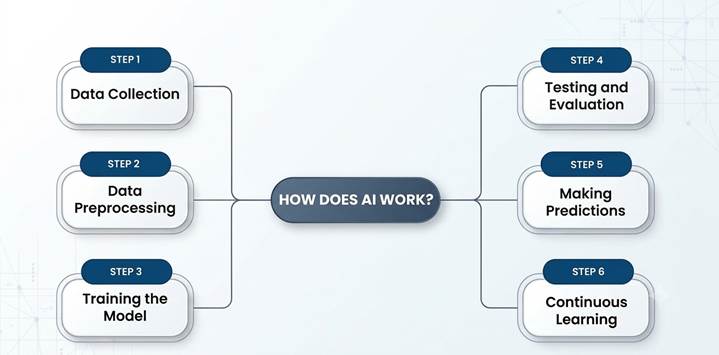
1. Data Collection
The first step is collecting data. AI systems need information to understand patterns and perform tasks.
For example, an AI system that recognises animals may use thousands of images of cats, dogs and other animals.
2. Data Processing
After collecting data, the system processes it. This step helps organise information and remove errors or unnecessary details.
Good-quality data helps AI systems produce better results.
3. Training the AI Model
The AI model studies the collected data and learns patterns. It uses algorithms to understand relationships between different pieces of information.
For example, an AI model trained with different fruit images can learn to identify apples, bananas and oranges.
4. Making Predictions
After training, the model can use what it has learned to analyse new information and make predictions.
For example, an AI system can study previous sales data and estimate future product demand.
5. Improving Performance
AI models can be tested and improved. Developers check their results and make changes when required.
This helps improve accuracy and performance over time.
What Are the Different Types of Artificial Intelligence?
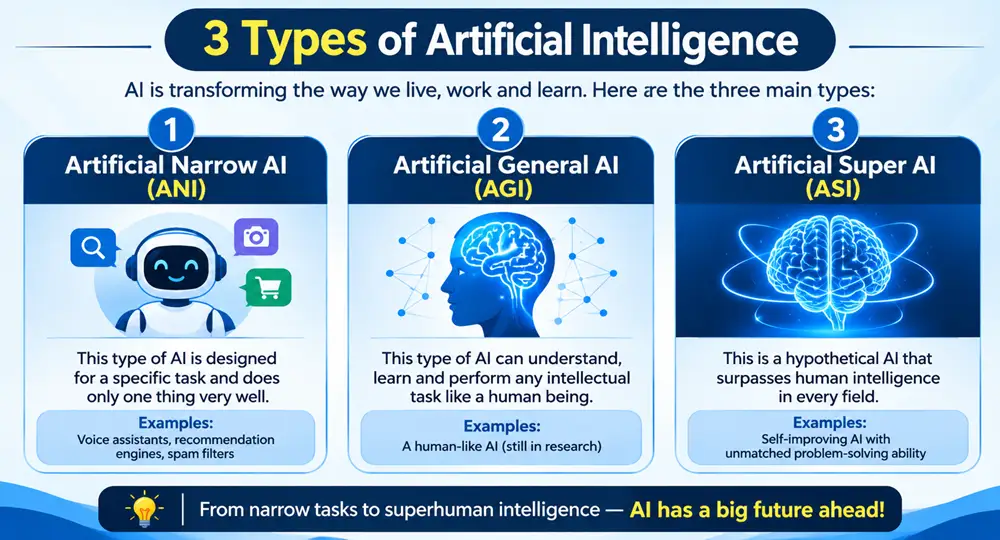
Artificial Intelligence can be classified in different ways. One common classification is based on the intelligence and capabilities of AI systems.
The three commonly discussed types are Narrow AI, General AI and Super AI.
| Types of AI | Meaning and Capabilities | Examples | Current Status |
|---|---|---|---|
| Narrow AI (Weak AI) | Designed to perform specific tasks or a limited set of activities. It works within its programmed purpose and cannot perform every task like a human. | Voice assistants, chatbots, face recognition, spam filters and recommendation systems. | Available Today |
| General AI (Strong AI) | A theoretical type of AI that could understand, learn and perform a wide range of intellectual tasks at a human-like level. | Hypothetical AI systems capable of learning new skills and solving different types of problems independently. | Not Achieved Yet |
| Super AI | A hypothetical form of AI that could exceed human intelligence across many areas, including learning, reasoning and problem-solving. | Hypothetical systems with intellectual capabilities beyond human performance. | Future Concept |
What Are the Main Technologies Used in Artificial Intelligence?
| AI Technology | Meaning | Common Applications |
|---|---|---|
| Machine Learning (ML) | Allows computers to learn patterns from data and make predictions without needing separate instructions for every situation. | Product recommendations, fraud detection, weather forecasting, customer behaviour analysis and predictive maintenance. |
| Deep Learning | A specialised branch of Machine Learning that uses multi-layered artificial neural networks to understand complex information. | Image recognition, speech recognition, facial recognition and language processing. |
| Natural Language Processing (NLP) | Helps computers understand, analyse and generate human language in written and spoken form. | Language translation, AI chatbots, voice assistants, text summarisation and speech recognition. |
| Computer Vision | Enables computers to analyse and understand images and videos by identifying objects, faces, shapes and visual details. | Security cameras, medical image analysis, quality inspection and self-driving vehicle systems. |
| Generative AI | Creates new content, such as text, images, audio, videos and computer code, based on patterns learned from existing data. | AI writing tools, image generators, video creation, coding assistants and content generation. |
Difference Between AI, Machine Learning and Deep Learning
| Technology | Meaning | Example |
| Artificial Intelligence | Broad field of creating intelligent systems | Smart assistants |
| Machine Learning | Systems learn patterns from data | Product recommendations |
| Deep Learning | Uses multi-layer neural networks | Image recognition |
| Natural Language Processing | Helps machines understand human language | Language translation |
| Computer Vision | Helps machines understand images and videos | Face recognition |
Machine Learning and Deep Learning are parts of the wider field of Artificial Intelligence.
What Are the Uses of Artificial Intelligence?
| Industry / Sector | How Artificial Intelligence Is Used | Common Applications |
|---|---|---|
| Education | Helps students learn, supports teachers and makes educational activities easier to manage. | Personalised learning, AI learning assistants, automated practice tests, language learning, study summaries and student performance analysis. |
| Healthcare | Supports medical professionals in analysing health information, medical images and research data. | Medical image analysis, patient data management, drug discovery support, disease risk prediction and hospital administration. |
| Banking | Helps financial organisations analyse transactions, identify unusual activities and improve customer services. | Fraud detection, transaction monitoring, banking chatbots, risk analysis and personalised banking services. |
| Agriculture | Helps farmers analyse weather, soil and crop information to support agricultural activities. | Crop health monitoring, smart irrigation, pest detection, weather analysis and crop yield prediction. |
| Business | Helps companies understand customer behaviour, analyse information and manage daily operations. | Customer service automation, sales forecasting, market research, product recommendations and inventory management. |
| Transportation | Supports transportation systems through data analysis, traffic monitoring and route planning. | Traffic prediction, route planning, driver assistance, vehicle monitoring and autonomous vehicle research. |
| Entertainment | Helps digital platforms recommend content and supports creative activities. | Movie and music recommendations, video editing, animation, gaming and AI-based content creation. |
Applications of Artificial Intelligence Across Industries
| Industry | Uses of AI |
| Education | Personalised learning and study support |
| Healthcare | Medical image analysis and research |
| Banking | Fraud detection and transaction monitoring |
| Agriculture | Crop monitoring and smart irrigation |
| Business | Customer analysis and sales forecasting |
| Transportation | Traffic prediction and route planning |
| Entertainment | Content recommendations and gaming |
| Manufacturing | Quality checks and predictive maintenance |
What Are the Benefits of Artificial Intelligence?
| Benefits of AI | Explanation | Practical Examples |
|---|---|---|
| Saves Time | AI automates repetitive tasks and helps people complete work faster, allowing more time for important activities. | Document organisation, report preparation, data sorting and text summarisation. |
| Reduces Human Errors | AI can help reduce mistakes in repetitive tasks such as calculations, data entry and information processing. | Automated calculations, data checking and information processing. |
| Handles Large Amounts of Data | AI can process large datasets and identify patterns that may be difficult to find manually. | Customer behaviour analysis, market research and business trend analysis. |
| Improves Customer Support | AI chatbots can answer common customer questions and provide basic support at different times of the day. | Customer service chatbots, order tracking and product information. |
| Supports Better Decisions | AI analyses available information and provides predictions or suggestions that help professionals evaluate different situations. | Sales forecasting, business planning and risk analysis. |
| Encourages Innovation | AI creates new opportunities for research, development and problem-solving across different industries. | Software development, healthcare research, educational tools and engineering solutions. |
What Are the Disadvantages and Limitations of Artificial Intelligence?
Although Artificial Intelligence offers many benefits, it also has some limitations. Understanding these limitations is important for using AI responsibly.
| Disadvantage | Explanation |
| High Development Cost | Building and maintaining advanced AI systems can require significant resources. |
| Data Privacy Risks | AI systems may process personal or sensitive information. |
| Incorrect Results | AI can provide inaccurate or misleading information. |
| Job Changes | Automation can change the skills required for certain jobs. |
| Bias in Results | Poor or unbalanced training data can lead to unfair results. |
| Limited Human Understanding | AI does not understand emotions and situations in the same way humans do. |
| Security Risks | AI systems can be misused or become targets of cyberattacks. |
Why Is Responsible Use of AI Important?
Responsible AI use means using technology carefully, fairly, and safely.
Students, teachers, and professionals should check AI-generated information before using it. They should also protect personal information and avoid sharing private data with unknown tools.
AI should support human knowledge and decision-making rather than replace independent thinking.
What Skills Are Required to Learn Artificial Intelligence?
Students interested in Artificial Intelligence should develop a combination of technical and practical skills.
You do not need to master everything at the beginning. You can start with basic computer knowledge and gradually learn advanced concepts.
The following skills can help build a strong foundation.
| Skill | Why Is It Important? |
| Programming | Helps develop software and AI applications. |
| Mathematics | Supports calculations and AI model development. |
| Statistics | Helps understand and analyse data. |
| Problem-Solving | Helps find solutions to technical problems. |
| Data Analysis | Helps identify patterns in information. |
| Logical Thinking | Helps understand algorithms and computer programmes. |
| Communication | Helps explain technical ideas clearly. |
| Critical Thinking | Helps check AI results and identify mistakes. |
Which Programming Languages Are Useful for AI?
Some programming languages are commonly used in AI development.
- Python: Used for machine learning, data analysis and AI development.
- R: Used for statistics and data analysis.
- Java: Used in software development and some AI applications.
- C++: Used in performance-focused software and certain AI systems.
- SQL: Used to manage and retrieve information from databases.
Python is a useful starting point for students because it has a simple structure and supports many AI development tools.
What Are the Career Opportunities in Artificial Intelligence?
Artificial Intelligence is creating new career opportunities across different industries. Organisations need skilled professionals who can develop software, analyse data, and work with intelligent systems.
Students with relevant education and technical skills can explore several career paths.
Popular AI Career Options
| Career Option | Main Responsibilities |
| AI Engineer | Develops and maintains AI-based applications. |
| Machine Learning Engineer | Builds and improves machine learning models. |
| Data Scientist | Studies data and finds useful patterns. |
| Data Analyst | Analyses information and prepares reports. |
| Robotics Engineer | Develops and works with robotic systems. |
| NLP Engineer | Develops systems that understand human language. |
| Computer Vision Engineer | Develops applications that analyse images and videos. |
| AI Researcher | Studies new methods and improvements in AI. |
| Business Intelligence Analyst | Uses data to support business decisions. |
| Software Developer | Builds software applications and digital solutions. |
Which Industries Hire AI Professionals?
AI-related skills can be useful in many sectors, including:
| Industry | How AI Professionals Contribute | Common Job Opportunities |
|---|---|---|
| Information Technology (IT) | Develop AI applications, machine learning models, and intelligent software solutions. | AI Engineer, Machine Learning Engineer, Data Scientist |
| Banking and Finance | Build systems for fraud detection, financial analysis and risk management. | AI Analyst, Financial Data Analyst, AI Developer |
| Healthcare | Work on medical image analysis, healthcare data and AI-based research solutions. | Healthcare Data Analyst, AI Researcher, Medical AI Specialist |
| Education | Develop intelligent learning tools, automated assessment systems and personalised learning solutions. | Educational Technology Specialist, AI Developer, Data Analyst |
| Manufacturing | Use AI for quality inspection, production monitoring and predictive maintenance. | Automation Engineer, Robotics Engineer, AI Engineer |
| E-commerce | Develop product recommendation systems, customer behaviour analysis and demand forecasting tools. | Data Scientist, AI Analyst, Machine Learning Engineer |
| Agriculture | Work on crop monitoring, smart farming, pest detection and agricultural data analysis. | Agri-Tech Specialist, AI Engineer, Data Analyst |
| Telecommunications | Apply AI to network monitoring, customer support and communication system management. | AI Specialist, Network Data Analyst, AI Developer |
| Automotive | Develop intelligent driver assistance, vehicle monitoring and autonomous driving technologies. | Robotics Engineer, Computer Vision Engineer, AI Engineer |
| Research and Development | Explore new AI technologies, develop machine learning models and conduct experiments. | AI Research Scientist, Research Analyst, Machine Learning Researcher |
What Is the Salary of an AI Professional in India?
The salary of an Artificial Intelligence (AI) professional in India depends on qualifications, technical skills, work experience, job role, location and employer.
Fresh graduates and experienced professionals may receive different salary packages. Professionals with strong programming, machine learning and data analysis skills may explore better career opportunities.
There is no fixed salary for every AI job. However, the following table provides an approximate salary range for different AI professionals in India in 2026.
Artificial Intelligence Salary in India by Experience
| Experience Level | Approximate Annual Salary | Approximate Monthly Salary |
|---|---|---|
| Fresher (0–2 Years) | ₹4–8 LPA | ₹33,000–₹67,000 |
| Mid-Level (3–5 Years) | ₹8–18 LPA | ₹67,000–₹1,50,000 |
| Experienced (6–10 Years) | ₹15–30 LPA | ₹1,25,000–₹2,50,000 |
| Senior Professional (10+ Years) | ₹25–50 LPA or more | ₹2,08,000–₹4,16,000 or more |
LPA means Lakhs Per Annum. Monthly figures are annual salary divided by 12, not guaranteed take-home pay.
AI Salary in India by Job Role
| AI Job Role | Approximate Annual Salary |
|---|---|
| Artificial Intelligence Engineer | ₹5–15 LPA |
| Machine Learning Engineer | ₹6–14 LPA |
| Data Scientist | ₹6–12 LPA |
| Deep Learning Engineer | ₹6–15 LPA |
| Natural Language Processing (NLP) Engineer | ₹6–15 LPA |
| Computer Vision Engineer | ₹5–14 LPA |
| AI Research Scientist | ₹8–20 LPA or more |
| Generative AI Engineer | ₹8–18 LPA |
These are indicative salary ranges for educational guidance, not guaranteed starting packages. Actual compensation varies by employer, experience and skills.
Factors That Affect AI Professional Salaries
Several factors can influence how much an AI professional earns:
- Educational Qualification: A relevant degree in Computer Science, AI, Data Science or a related field can help build a foundation for AI careers.
- Technical Skills: Knowledge of Python, Machine Learning, Deep Learning and data analysis can improve job opportunities.
- Work Experience: Professionals with practical experience and completed projects may qualify for higher-paying positions.
- Specialisation: Skills in Generative AI, NLP and Computer Vision can open specialised career opportunities.
- Company and Location: Salary packages may differ between startups, IT companies and large technology organisations.
Students should focus on building practical knowledge, completing projects and developing problem-solving skills to improve their career prospects.
Which Courses Can You Study to Build a Career in Artificial Intelligence?
Students interested in Artificial Intelligence can choose undergraduate or postgraduate programmes based on their educational qualifications and career goals.
Some common study options include:
| Course | Level | General Duration |
| B.Tech in Artificial Intelligence and Data Science | Undergraduate | 4 Years |
| BCA in Artificial Intelligence and Data Science | Undergraduate | 3 Years |
| MCA in Artificial Intelligence and Data Science | Postgraduate | 2 Years |
| M.Tech in Artificial Intelligence and Data Science | Postgraduate | 2 Years |
Note: Durations are general programme durations. Actual programme structures and eligibility requirements should be checked before admission.
Subjects Taught in Artificial Intelligence Courses
Artificial Intelligence courses cover different subjects related to computer science, programming, mathematics, data analysis and intelligent technologies. The exact syllabus may vary depending on the course, university and programme level.
The following table highlights some common subjects taught in Artificial Intelligence courses.
| Subject | What Students Learn |
|---|---|
| Fundamentals of Computer Science | Basic computer concepts, computer systems and the fundamentals of computing. |
| Programming Languages | Writing computer programmes using languages such as Python, Java and C++. |
| Data Structures and Algorithms | Organising data and developing solutions to computational problems. |
| Mathematics for Computing | Mathematical concepts, statistics, probability and linear algebra used in AI. |
| Database Management Systems | Storing, organising, managing and retrieving information from databases. |
| Machine Learning | Teaching computers to identify patterns in data and make predictions. |
| Deep Learning | Understanding artificial neural networks and advanced learning methods. |
| Neural Networks | Learning how interconnected computing systems process information. |
| Natural Language Processing (NLP) | Developing systems that understand and process human language. |
| Data Analytics | Analysing data to identify patterns, trends and useful information. |
| Cloud Computing | Understanding online computing resources, data storage and cloud-based applications. |
| Computer Vision | Developing systems that analyse and understand images and videos. |
| Internet of Things (IoT) | Understanding connected devices and how they collect and exchange information. |
These subjects help students develop programming, analytical and problem-solving skills. They also provide knowledge of how intelligent systems are designed, developed and used in different industries.
Study Artificial Intelligence and Data Science at DBU
At Desh Bhagat University, we understand that Artificial Intelligence and Data Science are important areas of modern technology.
Our Faculty of Engineering Technology and Computing offers programmes related to Computer Science and Artificial Intelligence. We provide study options for students who want to develop knowledge in programming, data analysis and intelligent computer systems.
Students can explore the following programmes:
1. B.Tech in Artificial Intelligence and Data Science
Our B.Tech in Artificial Intelligence and Data Science is an undergraduate engineering programme with a duration of four years.
It helps students build a foundation in computer science, programming, machine learning and data science.
Students can explore areas such as:
- Artificial Intelligence
- Machine Learning
- Deep Learning
- Data Science
- Neural Networks
- Natural Language Processing
- Cloud Computing
- Internet of Things
Who can consider this course?
Students who have completed 10+2 with the required subjects and meet the applicable eligibility requirements can explore this programme.
Read more: B.Tech in Artificial Intelligence and Data Science.
2. BCA in Artificial Intelligence and Data Science
Our BCA in Artificial Intelligence and Data Science is an undergraduate programme designed for students interested in computer applications and modern technologies.
It provides a foundation in programming, computer applications, data analysis and AI concepts.
Students can develop knowledge in:
- Computer Programming
- Data Structures
- Database Management
- Artificial Intelligence
- Machine Learning Basics
- Data Analysis
- Computer Applications
The programme is suitable for students who want to build a career in computer applications and explore AI-related technologies.
3. MCA in Artificial Intelligence and Data Science
Our MCA in Artificial Intelligence and Data Science is a postgraduate programme with a general duration of two years.
It allows students to develop advanced knowledge of computer applications and explore modern areas of computing.
Students can study areas such as:
- Advanced Programming
- Artificial Intelligence
- Machine Learning
- Data Science
- Database Management
- Computer Networks
- Software Development
This programme can be considered by graduates who want to improve their technical knowledge and explore advanced career opportunities.
4. M.Tech in Artificial Intelligence and Data Science
Our M.Tech in Artificial Intelligence and Data Science is a postgraduate engineering programme for students interested in advanced computing and technical research.
It helps students explore specialised areas of AI, data science, and computer science.
Students can develop knowledge in advanced algorithms, machine learning, data analytics, and research-based problem-solving.
Read more: M.Tech in Artificial Intelligence and Data Science
Why Choose Desh Bhagat University for Artificial Intelligence Studies?
Choosing the right university is an important step towards building a successful career. At Desh Bhagat University, we offer programmes in Computer Science and Engineering and Computer Applications for students interested in modern technology.
Here are some reasons to explore our programmes:
- Relevant Programme Options: We offer undergraduate and postgraduate programmes related to Artificial Intelligence and Data Science.
- Multiple Study Levels: Students can explore B.Tech, BCA, MCA and M.Tech programmes.
- Computer Science Foundation: Our programmes cover important areas of computing, programming and technology.
- Future-Focused Learning: Students can explore subjects related to AI, machine learning and data science.
- Career Opportunities: Our programmes help students develop knowledge relevant to different technology-related career paths.
We encourage students to understand the course structure, eligibility requirements and career opportunities before selecting a programme.
What Is the Future Scope of Artificial Intelligence?
The future of Artificial Intelligence offers many possibilities. AI is becoming an important part of different industries, and organisations are exploring new ways to use this technology.
Some important areas of future development include:
- Healthcare: AI may support medical research, health data analysis and medical imaging.
- Education: AI-based tools may provide more personalised learning support.
- Robotics: Intelligent systems may support manufacturing and other technical operations.
- Agriculture: AI may help improve crop monitoring and resource management.
- Cybersecurity: AI can help identify unusual digital activities and potential security threats.
- Business: Organisations may use AI to understand customer behaviour and improve planning.
- Transportation: AI may support traffic management and vehicle safety systems.
The future of AI will also depend on responsible development, data privacy, human supervision and proper security measures.
Students who develop strong technical knowledge and keep learning new skills can prepare themselves for changing career requirements.
Conclusion
Artificial Intelligence is one of the important technologies shaping the modern world. It allows machines and computer systems to perform tasks such as learning, analysing information, recognising patterns and making predictions.
Today, AI is used in education, healthcare, banking, agriculture, transportation, business and entertainment. It offers many benefits, including time savings, automation and better data analysis. However, it also has limitations related to privacy, accuracy, security and responsible use.
For students interested in this growing field, learning programming, mathematics, data analysis and machine learning can be a good starting point.
At Desh Bhagat University, we offer programmes related to Artificial Intelligence and Data Science through our Computer Science and Engineering and Computer Applications departments. We encourage students to explore these programmes and develop the knowledge and skills needed for technology-related careers.
Frequently Asked Questions
Artificial Intelligence does not have a single inventor. Many researchers contributed to its development. John McCarthy is widely known for introducing the term Artificial Intelligence in 1956.
AI can be challenging at an advanced level, but beginners can start with basic computer knowledge, mathematics and programming. Regular practice makes learning easier.
Basic AI awareness does not require coding. However, programming knowledge is important for students who want to develop AI applications and work in technical AI roles.
AI can automate certain tasks, but it also creates new job opportunities. Human creativity, communication, critical thinking and decision-making remain important in many professions.
Generative AI is a technology that creates new content, such as text, images, videos, audio and computer code. It learns patterns from existing data to produce new results.
Human intelligence includes emotions, personal experiences, creativity and complex reasoning. AI processes information and performs tasks based on its training, design and available data.
Yes, students can use AI tools for learning, research support, explanations and study planning. However, they should verify information and follow their institution’s academic rules.
Mathematics helps students understand algorithms, machine learning models and data analysis. Topics such as statistics, probability, algebra and calculus are useful in advanced AI studies.
Data Science focuses on collecting, processing and analysing data to find useful information. Artificial Intelligence focuses on developing systems that can perform tasks requiring intelligent behaviour. Both fields are closely connected.
Yes, small businesses can use AI for customer support, marketing, sales analysis, content assistance and business planning. These tools can help save time and improve daily operations.