BAMS vs BDS vs Pharm D: Salary, Scope, & Career Comparison
August 4, 2026 2026-08-05 4:36BAMS vs BDS vs Pharm D: Salary, Scope, & Career Comparison
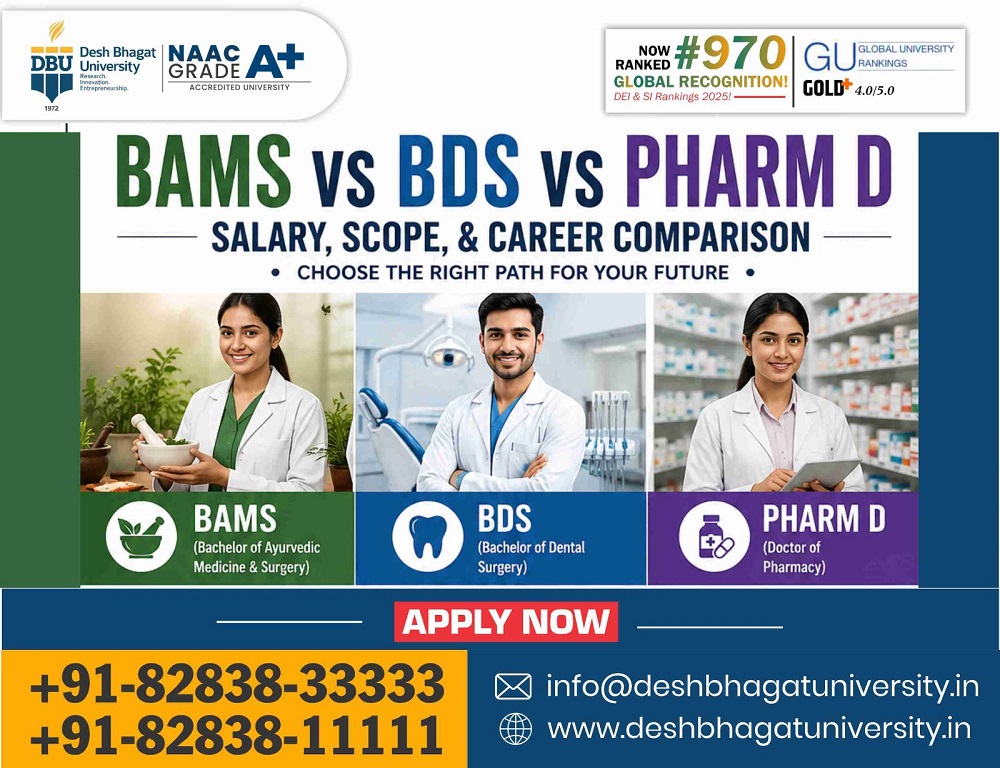
BAMS vs BDS vs Pharm D: Salary, Scope, & Career Comparison
Choosing the right healthcare course after Class 12 is one of the most important decisions for students who want to build a successful career in the medical field. While MBBS is a popular choice, many students also consider professional courses like BAMS (Bachelor of Ayurvedic Medicine and Surgery), BDS (Bachelor of Dental Surgery), and Pharm D (Doctor of Pharmacy).
Each of these courses offers unique career opportunities, practical training, and excellent future growth. However, they differ in areas such as course duration, subjects, salary, career scope, and work environment. Understanding these differences can help you choose the course that matches your interests and career goals.
At Desh Bhagat University, we offer healthcare programs that combine academic learning with practical exposure to prepare students for the modern healthcare industry.
In this guide, we compare BAMS vs BDS vs Pharm D in detail, including salary, scope, eligibility, course duration, subjects, and career opportunities.
BAMS vs BDS vs Pharm D: Quick Comparison
If you are looking for a short answer, here is a quick comparison of these three popular healthcare courses.
| Feature | BAMS | BDS | Pharm D |
| Full Form | Bachelor of Ayurvedic Medicine and Surgery | Bachelor of Dental Surgery | Doctor of Pharmacy |
| Duration | 5.5 Years | 5 Years | 6 Years |
| Main Focus | Ayurveda | Dentistry | Clinical Pharmacy |
| Internship | Yes | Yes | Yes |
| Patient Interaction | High | High | High |
| Government Jobs | Yes | Yes | Yes |
| Higher Studies | MD (Ayurveda), PhD | MDS, PhD | Clinical Pharmacy, MPH, MBA, PhD |
All three courses provide rewarding careers in healthcare. The best choice depends on your interests, strengths, and long-term career plans.
What is BAMS?
BAMS (Bachelor of Ayurvedic Medicine and Surgery) is a professional undergraduate degree that focuses on Ayurveda, one of India’s oldest systems of medicine.
The course combines traditional Ayurvedic knowledge with modern medical science. Students learn about the human body, diagnosis, herbal medicines, preventive healthcare, and patient management.
After completing the course and fulfilling the applicable professional requirements, graduates can work as Ayurvedic doctors in hospitals, wellness centres, clinics, and healthcare organizations.
BAMS is best for Students Who:
- Are interested in natural healing
- Want to study Ayurveda
- Enjoy working directly with patients
- Want to build a career in holistic healthcare
What is BDS?
BDS (Bachelor of Dental Surgery) is the professional degree required to become a dental professional.
The course focuses on diagnosing, preventing, and treating diseases related to the teeth, gums, jaw, and mouth.
Students receive classroom education along with practical clinical training, helping them develop the skills needed to provide dental care.
BDS is best for Students Who:
- Enjoy Biology
- Like precision-based work
- Want to become a dental professional
- Are interested in cosmetic dentistry and oral healthcare
What is Pharm D?
Pharm D (Doctor of Pharmacy) is a professional doctoral-level pharmacy program that focuses on medicines, patient care, and clinical pharmacy.
Unlike traditional pharmacy programs, Pharm D prepares students to work closely with doctors and other healthcare professionals to improve medication safety and patient outcomes.
Students receive extensive hospital-based clinical training during the course.
Pharm D is best for Students Who:
- Are interested in medicines
- Enjoy hospital-based healthcare
- Like patient counselling
- Want a career in clinical pharmacy or the pharmaceutical industry
BAMS vs BDS vs Pharm D: Course Highlights
| Feature | BAMS | BDS | Pharm D |
| Degree Type | Undergraduate Professional Degree | Undergraduate Professional Degree | Professional Doctoral Degree |
| Duration | 5.5 Years | 5 Years | 6 Years |
| Internship | 1 Year | 1 Year | 1 Year |
| Main Area | Ayurveda | Dentistry | Clinical Pharmacy |
| Clinical Training | Yes | Yes | Yes |
| Career Type | Ayurvedic Healthcare | Dental Healthcare | Hospital & Clinical Pharmacy |
Eligibility Criteria
Before choosing any healthcare course, students should understand the eligibility requirements.
The basic eligibility for all three courses is similar.
| Eligibility Requirement | BAMS | BDS | Pharm D |
| Class 12 Passed | ✔ | ✔ | ✔ |
| Physics | ✔ | ✔ | ✔ |
| Chemistry | ✔ | ✔ | ✔ |
| Biology | ✔ | ✔ | ✔* |
| Mathematics | Not Required | Not Required | Accepted in some cases* |
*Eligibility requirements may vary depending on the admission guidelines. Students should always check the latest admission criteria before applying.
Course Duration Comparison
Course duration is another important factor while selecting a healthcare program.
| Course | Duration |
| BDS | 5 Years |
| BAMS | 5.5 Years |
| Pharm D | 6 Years |
Subjects Comparison: BAMS vs BDS vs Pharm D
| BAMS | BDS | Pharm D |
|---|---|---|
| Human Anatomy | Dental Anatomy | Human Anatomy |
| Human Physiology | Human Anatomy | Human Physiology |
| Ayurvedic Principles | Oral Pathology | Pharmacology |
| Pharmacology | Orthodontics | Clinical Pharmacy |
| Pathology | Prosthodontics | Hospital Pharmacy |
| Panchakarma | Oral Surgery | Pharmaceutical Chemistry |
| Herbal Medicine | Conservative Dentistry | Pharmacotherapeutics |
| Surgery | Periodontology | Microbiology |
| Community Medicine | Pediatric Dentistry | Clinical Toxicology |
| Preventive Healthcare | Public Health Dentistry | Patient Counselling & Drug Information Services |
Key Focus
Pharm D: Medicines, clinical pharmacy, and hospital-based patient care..
BAMS: Ayurveda, natural healing, and preventive healthcare.
BDS: Oral healthcare, dental diagnosis, and treatment.
Practical Training Comparison
Practical learning is an important part of every healthcare course.
| Training Area | BAMS | BDS | Pharm D |
| Hospital Exposure | ✔ | ✔ | ✔ |
| Clinical Practice | ✔ | ✔ | ✔ |
| Laboratory Training | ✔ | ✔ | ✔ |
| Internship | ✔ | ✔ | ✔ |
| Patient Counselling | Moderate | High | Very High |
| Surgical Exposure | Basic | High | Limited |
All three programs provide practical experience, but the type of training differs based on the profession.
Skills Developed: BAMS vs BDS vs Pharm D
| Skill Area | BAMS | BDS | Pharm D |
|---|---|---|---|
| Patient Diagnosis | ✔️ | ✔️ | ✔️ |
| Treatment Planning | Ayurvedic Treatment | Dental Treatment | Medication Therapy |
| Clinical Skills | Clinical Observation | Dental Procedures | Clinical Decision-Making |
| Patient Care | ✔️ | ✔️ | ✔️ |
| Communication Skills | ✔️ | ✔️ | Patient Counselling |
| Specialized Skills | Herbal Medicine Knowledge | Hand-Eye Coordination, Infection Control | Drug Safety Monitoring, Medication Management |
| Teamwork | Healthcare Collaboration | Dental Team Collaboration | Healthcare Teamwork |
Key Takeaway
- BAMS: Focuses on diagnosis, Ayurveda, and natural healing.
- BDS: Develops dental treatment skills, precision, and patient care.
- Pharm D: Builds expertise in medicines, clinical pharmacy, and patient safety.
Which Course Has Better Clinical Exposure?
All three courses include clinical training, but the focus is different.
- BAMS students learn Ayurvedic diagnosis, herbal treatments, and patient care.
- BDS students gain hands-on experience in diagnosing and treating dental conditions.
- Pharm D students receive extensive hospital-based clinical training, working with healthcare teams to improve medication therapy and patient safety.
The best option depends on the type of healthcare career you want to pursue.
BAMS vs BDS vs Pharm D: Salary Comparison
Salary is one of the most important factors students consider before choosing a healthcare course. However, your earnings depend on several factors, such as your experience, skills, specialization, location, and employer.
Fresh graduates usually start with a moderate salary, but income generally increases with experience and additional qualifications.
Average Salary Comparison
| Course | Starting Salary | Experienced Salary |
| BAMS | ₹3 LPA – ₹5 LPA | ₹8 LPA – ₹12+ LPA |
| BDS | ₹3 LPA – ₹6 LPA | ₹10 LPA – ₹18+ LPA |
| Pharm D | ₹4 LPA – ₹7 LPA | ₹12 LPA – ₹20+ LPA |
Note: Salaries are approximate and may vary based on the employer, city, experience, and individual performance.
Salary Growth After Experience
Healthcare careers offer steady salary growth as professionals gain practical experience and build expertise.
| Experience | BAMS | BDS | Pharm D |
| Fresh Graduate | ₹3–5 LPA | ₹3–6 LPA | ₹4–7 LPA |
| 3–5 Years | ₹5–8 LPA | ₹6–10 LPA | ₹7–12 LPA |
| 5–10 Years | ₹8–12+ LPA | ₹10–18+ LPA | ₹12–20+ LPA |
Professionals who pursue higher studies, specialize in their field, or establish successful private practices may earn significantly higher incomes.
Career Scope Comparison: BAMS vs BDS vs Pharm D
| Category | BAMS | BDS | Pharm D |
|---|---|---|---|
| Popular Careers | Ayurvedic Doctor, Medical Officer, Wellness Consultant, Panchakarma Specialist, Research Associate | Dentist, Dental Surgeon, Cosmetic Dentist, Hospital Dentist, Public Health Dentist | Clinical Pharmacist, Hospital Pharmacist, Drug Safety Associate, Clinical Research Associate, Medical Writer |
| Main Workplaces | Ayurvedic Hospitals, Wellness Centres, Government Hospitals, Private Clinics, Research Institutes | Dental Clinics, Multi-specialty Hospitals, Government Hospitals, Private Hospitals, Dental Colleges | Hospitals, Pharmaceutical Companies, Clinical Research Organizations, Drug Safety Centres, Healthcare Startups |
| Private Practice | ✔️ Ayurvedic Clinic | ✔️ Dental Clinic | ❌ Generally hospital and industry based |
| Government Jobs | ✔️ | ✔️ | ✔️ |
| Research Opportunities | Good | Good | Excellent |
| Teaching Opportunities | After Higher Studies | After MDS | After Higher Studies |
| Industry Demand | Growing demand for Ayurveda and wellness | Rising demand for oral healthcare | High demand in hospitals and the pharmaceutical industry |
Career Summary
- BAMS: Best for students who want to build a career in Ayurveda, wellness, and preventive healthcare.
- BDS: Ideal for students who want to become dental professionals and establish their own dental practice.
- Pharm D: Best suited for students interested in clinical pharmacy, hospitals, and the pharmaceutical industry.
Government Job Opportunities: BAMS vs BDS vs Pharm D
| Opportunity | BAMS | BDS | Pharm D |
|---|---|---|---|
| Government Hospitals | ✔️ Ayurvedic Hospitals | ✔️ Dental Hospitals | ✔️ Government Hospitals |
| Primary & Community Health Centres | ✔️ | Limited | ✔️ |
| Public Health Programs | ✔️ | ✔️ | ✔️ |
| Research Organizations | ✔️ | ✔️ | ✔️ |
| Healthcare Administration | ✔️ | ✔️ | ✔️ |
| Defence Services* | Limited | ✔️ | Limited |
| Teaching Institutions | ✔️ (After Higher Studies) | ✔️ (After MDS) | ✔️ (After Higher Studies) |
| Drug Safety & Pharmacovigilance | ❌ | ❌ | ✔️ |
*Note: Recruitment to government and defence positions depends on eligibility criteria, vacancies, and the recruitment rules announced by the respective authorities.
Private Sector Opportunities
The private healthcare industry offers excellent career growth across all three professions.
| Sector | BAMS | BDS | Pharm D |
| Hospitals | ✔ | ✔ | ✔ |
| Private Clinics | ✔ | ✔ | Limited |
| Pharmaceutical Companies | Limited | Limited | ✔✔ |
| Research | ✔ | ✔ | ✔✔ |
| Healthcare Startups | ✔ | ✔ | ✔ |
| Medical Colleges | ✔ | ✔ | ✔ |
Higher Education Options
Continuing education helps healthcare professionals gain specialized knowledge and improve career prospects.
| Course | Higher Education Options |
| BAMS | MD (Ayurveda), MPH, PhD |
| BDS | MDS, MPH, MBA, PhD |
| Pharm D | Clinical Pharmacy Specializations, MPH, MBA (Healthcare), PhD |
Higher qualifications can lead to teaching, research, leadership, and specialized clinical roles.
India vs Abroad Career Opportunities
Many students also consider international career opportunities.
| Feature | BAMS | BDS | Pharm D |
| Demand in India | Excellent | Excellent | Excellent |
| Demand Abroad | Good | Good | Very Good |
| Licensing Required Abroad | Yes | Yes | Yes |
| Research Opportunities | Good | Good | Excellent |
Students interested in working overseas should understand the licensing and registration requirements of the country where they plan to practice.
Admission Process at Desh Bhagat University
The admission process is simple and student-friendly.
| Step | Admission Process |
|---|---|
| Step 1 | Choose your preferred healthcare course |
| Step 2 | Check the eligibility criteria |
| Step 3 | Complete the application form |
| Step 4 | Submit the required documents |
| Step 5 | Complete the admission formalities |
| Step 6 | Start your healthcare education journey |
Students are encouraged to visit the official Desh Bhagat University website for the latest admission updates and eligibility requirements.
Which Course Has Better Scope?
The answer depends on your career goals rather than one course being universally better.
Choose BAMS if you:
- Want to become an Ayurvedic doctor.
- Are interested in natural healing and holistic healthcare.
- Want to work in wellness centres or Ayurvedic hospitals.
Choose BDS if you:
- Enjoy dentistry and oral healthcare.
- Want direct patient interaction.
- Plan to establish your own dental clinic in the future.
Choose Pharm D if you:
- Are interested in medicines and patient safety.
- Want to work in hospitals or the pharmaceutical industry.
- Enjoy clinical pharmacy and research.
Detailed Career Comparison
| Feature | BAMS | BDS | Pharm D |
| Patient Care | ★★★★★ | ★★★★★ | ★★★★★ |
| Private Practice | ★★★★★ | ★★★★★ | ★★☆☆☆* |
| Hospital Jobs | ★★★★☆ | ★★★★☆ | ★★★★★ |
| Pharmaceutical Industry | ★★☆☆☆ | ★☆☆☆☆ | ★★★★★ |
| Research Opportunities | ★★★★☆ | ★★★★☆ | ★★★★★ |
| Government Jobs | ★★★★☆ | ★★★★☆ | ★★★★☆ |
| Higher Studies | ★★★★★ | ★★★★★ | ★★★★★ |
| Global Opportunities | ★★★☆☆ | ★★★☆☆ | ★★★★★ |
*Private practice opportunities for Pharm D graduates depend on the professional role and applicable regulations.
BAMS vs BDS vs Pharm D: Which Course Should You Choose?
| Feature | BAMS | BDS | Pharm D |
|---|---|---|---|
| Best For | Students interested in Ayurveda and natural healing | Students who want to become dentists | Students interested in medicines and clinical pharmacy |
| Main Focus | Ayurvedic medicine and holistic healthcare | Oral and dental healthcare | Medicines, patient care, and clinical pharmacy |
| Patient Interaction | High | Very High | High |
| Hospital Opportunities | Yes | Yes | Excellent |
| Private Practice | Yes (Ayurvedic Clinic) | Yes (Dental Clinic) | Limited (mainly hospital and industry roles) |
| Research Opportunities | Moderate | Moderate | High |
| Higher Education | MD (Ayurveda), PG Courses | MDS | Pharm D (PB), M.Pharm, Clinical Research |
| International Scope | Moderate | Good | Excellent |
| Ideal Choice If You Want To… | Become an Ayurvedic doctor | Become a dentist | Become a clinical pharmacist or work in hospitals |
BAMS vs BDS vs Pharm D: Pros and Cons
| Course | Advantages | Considerations |
| BAMS | Natural healthcare, private practice, wellness sector, government jobs | Focused on Ayurveda |
| BDS | High patient interaction, private clinic opportunities, respected profession | Building a successful practice takes time and experience |
| Pharm D | Hospital careers, pharmaceutical industry, research, global opportunities | Longer course duration |
Which Course Has the Best Future?
All three courses have promising career prospects because India’s healthcare industry is expanding every year.
Future of BAMS
The demand for Ayurveda is increasing due to greater awareness of preventive healthcare, wellness, and natural treatment methods.
Future of BDS
Oral healthcare awareness continues to grow, creating opportunities in general dentistry, cosmetic dentistry, dental implants, orthodontics, and pediatric dentistry.
Future of Pharm D
Hospitals and healthcare organizations are placing greater emphasis on medication safety and clinical pharmacy services, creating more opportunities for Pharm D graduates.
Which Course Has Better Salary?
There is no guaranteed highest-paying course because salary depends on many factors.
These include:
- Experience
- Skills
- Specialization
- Employer
- Location
- Professional reputation
Many experienced professionals in BAMS, BDS, and Pharm D build successful and rewarding careers.
Which Course Has Better Scope Abroad?
All three courses offer international opportunities after fulfilling the licensing and registration requirements of the destination country.
However:
- BAMS has growing opportunities in wellness and Ayurvedic healthcare.
- BDS graduates may work internationally after meeting dental licensing requirements.
- Pharm D graduates often find strong opportunities in hospitals, clinical pharmacy, pharmacovigilance, research, and the pharmaceutical industry.
Students interested in working abroad should carefully review the regulations of the country where they wish to practice.
Why Choose Desh Bhagat University?
Choosing the right university is just as important as choosing the right healthcare course.
At Desh Bhagat University, we aim to prepare students with the knowledge, practical skills, and professional confidence needed for successful healthcare careers.
Experienced Faculty
Our experienced faculty members guide students through academic learning and practical training.
Modern Laboratories
Students gain hands-on experience in well-equipped laboratories that support practical learning.
Clinical Exposure
Healthcare programs include practical and clinical learning opportunities where applicable, helping students connect classroom knowledge with real-world healthcare practice.
Industry-Oriented Curriculum
Our curriculum is designed to meet current healthcare industry requirements and support career readiness.
Research and Innovation
Students are encouraged to participate in research activities and continuous learning.
Career Guidance
We provide career guidance, internship support, and placement assistance to help students prepare for professional opportunities.
Final Comparison Table
| Feature | BAMS | BDS | Pharm D |
| Course Duration | 5.5 Years | 5 Years | 6 Years |
| Main Focus | Ayurveda | Dentistry | Clinical Pharmacy |
| Patient Interaction | High | High | High |
| Hospital Exposure | Yes | Yes | Yes |
| Government Jobs | Yes | Yes | Yes |
| Private Practice | Yes | Yes | Limited (Role-dependent) |
| Pharmaceutical Industry | Limited | Limited | Excellent |
| Research Opportunities | Good | Good | Excellent |
| Higher Studies | MD (Ayurveda), PhD | MDS, PhD | MPH, MBA, PhD, Clinical Pharmacy |
| Abroad Opportunities | Good | Good | Very Good |
Conclusion
Choosing between BAMS, BDS, and Pharm D is an important decision that should be based on your interests and career goals rather than salary alone.
If you are passionate about Ayurveda and holistic healthcare, BAMS can be an excellent choice.
If you want to specialize in oral healthcare and dentistry, BDS offers a respected and rewarding career.
If you are interested in medicines, hospital practice, clinical pharmacy, and the pharmaceutical industry, Pharm D provides excellent career opportunities in India and abroad.
Each course contributes to the healthcare system in a unique way. With the right education, practical training, and continuous learning, you can build a successful and fulfilling healthcare career.
At Desh Bhagat University, we are committed to helping students achieve their professional goals through quality education, experienced faculty, modern infrastructure, practical learning, and career-focused training.
Frequently Asked Questions
The best course depends on your interests. BAMS is suitable for Ayurveda, BDS for dentistry, and Pharm D for clinical pharmacy and medicines.
Salary depends on experience, specialization, employer, and location. Experienced professionals in all three fields can earn attractive salaries.
They are different professional courses. Pharm D focuses on medicines and patient care, while BDS focuses on oral healthcare and dentistry.
Neither course is universally better. Choose BAMS if you are interested in Ayurveda and choose Pharm D if you are interested in medicines and hospital-based healthcare.
Qualified BAMS graduates may establish their own practice after meeting the applicable legal and professional registration requirements.
Yes. After completing the required degree and professional registration, BDS graduates may establish a dental practice in accordance with applicable regulations.
Yes. Pharm D graduates can work in hospitals as clinical pharmacists, hospital pharmacists, medication safety professionals, and in other patient-care roles.
BAMS, BDS, and Pharm D graduates can all apply for various government positions, depending on recruitment notifications and eligibility requirements.
All three courses offer international opportunities after meeting licensing requirements. Pharm D often has strong opportunities in clinical pharmacy and the pharmaceutical industry.
Desh Bhagat University offers experienced faculty, modern laboratories, practical learning, industry-oriented education, research opportunities, clinical exposure where applicable, and career guidance to help students build successful healthcare careers.