Master of Nutrition & Dietetics (Hons): Course Guide
September 19, 2026 2026-09-19 11:18Master of Nutrition & Dietetics (Hons): Course Guide
Master of Nutrition & Dietetics (Hons): Course Guide
Welcome to Desh Bhagat University. Nutrition is an important part of a healthy life. The food we eat gives our body energy and nutrients. Good nutrition also supports growth, development, immunity, and overall health.
Today, people are becoming more aware of the connection between food, lifestyle, and health. This has increased the need for trained professionals who understand nutrition and diet planning.
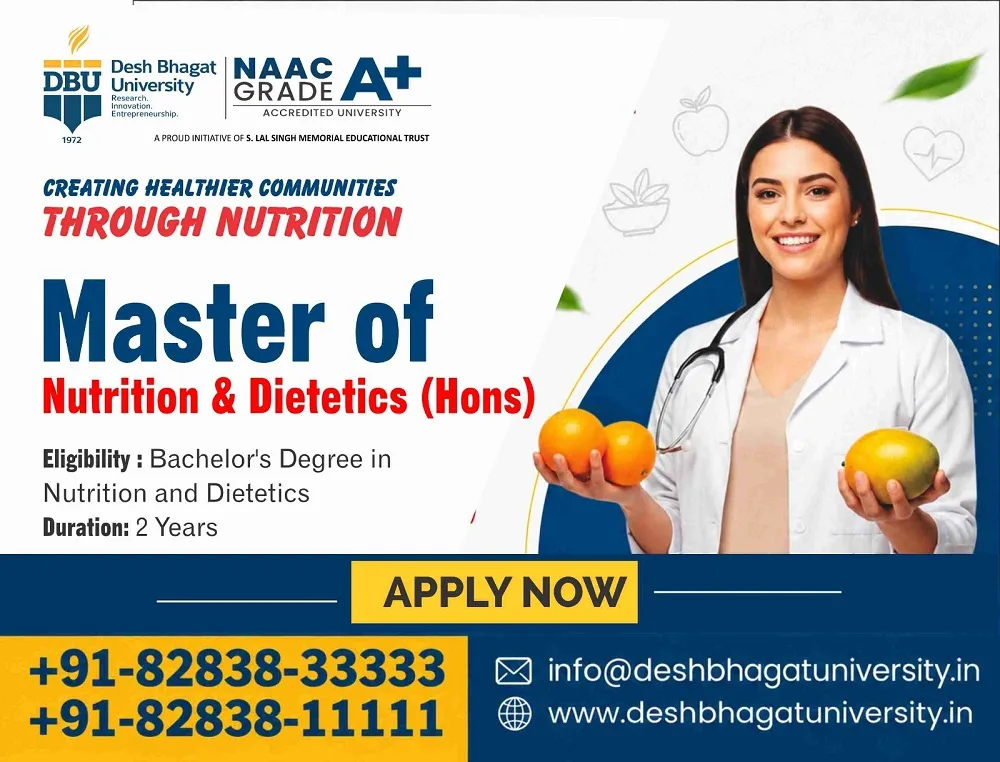
At Desh Bhagat University, we offer the Master of Nutrition & Dietetics (Hons) as a postgraduate programme for students who want to build advanced knowledge in nutrition and dietetics. Our programme has a duration of 2 years.
The programme helps students understand nutrition, diet planning, food science, human health, clinical nutrition, community nutrition, research, and professional practice. It also helps students develop communication, analytical, and practical skills that can support their future careers.
In this article, we explain the Master of Nutrition & Dietetics (Hons) course, duration, eligibility, admission process, subjects, skills, career scope, job opportunities, and frequently asked questions.
What is Master of Nutrition & Dietetics (Hons)?
The Master of Nutrition & Dietetics (Hons) is a two-year postgraduate programme that focuses on advanced study of nutrition, food, diet, and health.
Nutrition is the study of nutrients and how they affect the body. Dietetics focuses on using nutrition knowledge to plan suitable diets for individuals and groups.
During this programme, students can learn how food and nutrients are connected with human health. They can also learn how nutrition needs can change according to age, health condition, lifestyle, and other factors.
Our programme gives students an opportunity to develop knowledge in human nutrition, clinical nutrition, diet planning, food science, nutritional biochemistry, community nutrition, public health nutrition, therapeutic diets, nutrition assessment, food safety, research methods, and nutrition counselling. These areas help students understand the role of nutrition in health and wellbeing and develop practical knowledge for planning suitable diets, assessing nutritional needs, supporting healthy lifestyles, and providing nutrition guidance.
The programme is useful for students who want to build a professional career in nutrition, dietetics, healthcare, wellness, research, food-related industries, and other related areas.
Master of Nutrition & Dietetics (Hons) Course Highlights
The following table gives a quick overview of our programme.
| Particular | Details |
| Course Name | Master of Nutrition & Dietetics (Hons) |
| Course Level | Postgraduate |
| Duration | 2 Years |
| Study Pattern | Semester-based |
| Field | Nutrition, Dietetics and Healthcare |
| Main Focus | Nutrition, diet planning, health and food |
| Course Type | Postgraduate |
| Learning Areas | Clinical Nutrition, Dietetics, Food Science, Public Health and Research |
| Career Areas | Hospitals, Clinics, Wellness, Food Industry, Research, Education and Public Health |
The two-year duration is consistent with current postgraduate Nutrition and Dietetics programme structures. Published programme information also commonly uses four semesters for two-year master’s programmes.
Master of Nutrition & Dietetics (Hons) Duration
The duration of our Master of Nutrition & Dietetics (Hons) is 2 years.
The programme is designed to provide postgraduate-level learning over four semesters. During these two years, students can study advanced nutrition concepts and develop practical and professional skills.
Master of Nutrition & Dietetics (Hons) Eligibility
Students who want to apply for the Master of Nutrition & Dietetics (Hons) should have a relevant bachelor’s degree from a recognised university.
| Eligibility Requirement | Details |
| Course Level | Postgraduate |
| Required Qualification | Bachelor’s degree in a relevant field |
| Minimum Marks | 50% marks is the standard eligibility benchmark |
| Suitable Background | Nutrition, Dietetics, Food Science, Home Science, Life Sciences, Biological Sciences and related fields |
| University | Recognised University |
| Study Mode | Regular graduation background |
| Admission | As per university admission requirements |
Students from related health and biological science backgrounds can also find postgraduate Nutrition and Dietetics programmes that accept their qualifications. For example, published eligibility criteria include Home Science, Nutrition, Dietetics, Food Science, Biology, Microbiology, Clinical Biochemistry, Life Sciences, and related qualifications.
Who Can Apply for Master of Nutrition & Dietetics (Hons)?
Our programme can be considered by graduates who have an academic background related to nutrition, food, health, or biological sciences.
Students can consider applying if they:
- Have completed a relevant bachelor’s degree.
- Have the required minimum marks in graduation.
- Have studied subjects related to nutrition, food, health, or biological sciences.
- Are interested in food and human health.
- Want to build advanced knowledge in nutrition.
- Want to learn diet planning and nutrition assessment.
- Are interested in clinical nutrition.
- Want to explore careers in nutrition and dietetics.
- Want to develop research skills.
Students should have a genuine interest in health, food, science, and helping people make better nutrition choices.
Why Study Master of Nutrition & Dietetics (Hons)?
| Key Area | Why It Matters |
|---|---|
| Human Health | Learn how nutrition supports overall health, growth, and body functions. |
| Disease Prevention | Understand the role of healthy food and balanced nutrition in reducing health risks. |
| Clinical Nutrition | Develop knowledge of nutrition care and diet planning for different health needs. |
| Fitness & Wellness | Learn how nutrition can support fitness, active lifestyles, and overall wellbeing. |
| Sports Nutrition | Understand the importance of food and nutrients for physical activity and sports performance. |
| Public Health Nutrition | Explore nutrition-related needs at the community and population level. |
| Food Science | Build knowledge about food, nutrients, food quality, and their relationship with health. |
| Nutrition Research | Develop research skills to study nutrition, diet, food, and health-related topics. |
| Community Development | Understand how nutrition awareness and healthy eating practices can support communities. |
| Career Development | Gain subject knowledge and practical understanding for opportunities in nutrition, dietetics, healthcare, wellness, research, and related areas. |
At Desh Bhagat University, we help students build knowledge that connects nutrition, dietetics, food, and real-life health needs. The programme provides a strong foundation for students who want to develop their understanding of nutrition and explore careers in health, wellness, clinical nutrition, public health, research, and related fields.
What Do Students Learn in Master of Nutrition & Dietetics (Hons)?
Our programme covers important areas of nutrition and dietetics.
The exact subject names can vary according to the approved curriculum, but major learning areas can include:
| Subject Area | Main Learning |
| Advanced Nutrition | Advanced concepts of nutrients and human health |
| Clinical Nutrition | Nutrition in healthcare and clinical conditions |
| Dietetics | Diet planning and nutrition care |
| Nutritional Biochemistry | Chemical processes related to nutrients |
| Food Science | Food composition, quality and processing |
| Community Nutrition | Nutrition at community and population level |
| Public Health Nutrition | Nutrition and public health |
| Therapeutic Nutrition | Diets used to support different health conditions |
| Food Safety | Safe handling and quality of food |
| Research Methods | Basic and advanced research skills |
| Nutrition Assessment | Assessment of nutritional needs |
| Nutrition Counselling | Communication and nutrition guidance |
Skills Developed During Master of Nutrition & Dietetics (Hons)
At Desh Bhagat University, we focus on more than classroom learning. We also help students develop skills that can support professional growth.
| Skill | Why It Matters |
| Nutrition Knowledge | Helps understand food and nutrients |
| Diet Planning | Supports preparation of suitable diets |
| Nutrition Assessment | Helps identify nutritional needs |
| Communication | Helps explain nutrition information |
| Counselling | Supports nutrition education |
| Research | Helps understand scientific evidence |
| Critical Thinking | Helps analyse nutrition information |
| Food Safety | Supports safe food practices |
| Teamwork | Helps work with healthcare professionals |
| Problem Solving | Helps respond to nutrition-related challenges |
Practical Learning in Master of Nutrition & Dietetics (Hons)
Practical learning is an important part of Master of Nutrition & Dietetics (Hons). At Desh Bhagat University, we believe students should understand how academic knowledge can be applied to real-life situations. Practical learning helps students develop a better understanding of nutrition, diet planning, food, health, and research.
| Practical Learning Area | What Students Can Learn |
|---|---|
| Diet Planning | Learn how to plan balanced diets based on different nutritional needs. |
| Nutrition Assessment | Understand basic methods used to assess nutritional requirements and dietary habits. |
| Food Analysis | Develop knowledge of food composition, nutrients, and food quality. |
| Meal Planning | Learn how to prepare suitable meal plans according to individual and community needs. |
| Nutrition Counselling | Develop communication skills to provide basic nutrition guidance and support. |
| Food Safety | Understand important principles related to safe food handling, storage, and preparation. |
| Community Nutrition | Learn about nutrition needs, awareness, and healthy eating practices in communities. |
| Clinical Nutrition | Build knowledge of nutrition and diet planning in clinical and healthcare settings. |
| Research Activities | Develop an understanding of research methods and their application in nutrition and dietetics. |
Practical learning can help students build confidence, improve their understanding of nutrition and dietetics, and develop skills that can be useful in academic, clinical, community, research, and wellness-related settings.
Master of Nutrition & Dietetics (Hons) Career Scope
The career scope of Nutrition and Dietetics is spread across healthcare, wellness, food, research, education, and public health.
After completing the Master of Nutrition & Dietetics (Hons), graduates can explore opportunities in areas such as:
| Career Area | Possible Work |
| Hospitals | Clinical Nutrition and Dietetics |
| Clinics | Nutrition and Diet Counselling |
| Wellness Centres | Nutrition and Wellness Services |
| Fitness Centres | Nutrition Support |
| Food Industry | Food and Nutrition Roles |
| Research | Nutrition Research |
| Public Health | Community Nutrition |
| NGOs | Nutrition Programmes |
| Schools | Nutrition Education |
| Academic Institutions | Teaching and Research |
| Sports Nutrition | Nutrition Support for Fitness and Sports |
| Food Quality | Food Safety and Quality Work |
Current Nutrition and Dietetics programmes identify hospitals, clinics, wellness organisations, food and beverage industries, research, food quality laboratories, NGOs, and academic organisations as potential employment areas.
Jobs After Master of Nutrition & Dietetics (Hons)
Graduates of Master of Nutrition & Dietetics (Hons) can explore different career opportunities based on their skills, qualifications, experience, work setting, and applicable professional requirements.
| Job Role | Possible Work Area |
|---|---|
| Nutritionist | Nutrition guidance, diet planning, wellness, and health-related services |
| Dietitian | Diet planning and nutrition-related support in suitable professional settings |
| Clinical Nutritionist | Clinical nutrition and healthcare settings |
| Nutrition Consultant | Nutrition guidance, dietary planning, and wellness programmes |
| Public Health Nutritionist | Public health and community nutrition programmes |
| Community Nutritionist | Community health, nutrition awareness, and education |
| Sports Nutritionist | Sports, fitness, exercise, and performance-related nutrition |
| Wellness Nutritionist | Healthy eating, lifestyle, and wellness programmes |
| Food Quality Professional | Food quality and quality-related activities |
| Nutrition Researcher | Nutrition, food, health, and research projects |
| Research Assistant | Clinical, food, nutrition, and public health research |
| Nutrition Educator | Nutrition education and awareness programmes |
| Food Safety Professional | Food safety, quality, handling, and related activities |
| Academic Professional | Teaching, training, and academic activities, subject to applicable requirements |
Hospital and Clinical Careers
Hospitals and clinics are important work areas for nutrition professionals. Clinical nutrition professionals may work with healthcare teams and support nutrition-related patient care. Their work may include nutrition assessment, diet planning, patient counselling, nutrition education, monitoring dietary needs, and working with healthcare teams.
Clinical nutrition requires good knowledge of nutrition, diet planning, medical conditions, and professional communication.
Careers in Public Health Nutrition
Public health nutrition focuses on nutrition awareness and community health. Professionals can contribute to programmes and activities related to:
- Community nutrition programmes
- Nutrition education
- Health campaigns
- Maternal and child nutrition
- Nutrition surveys
- Public awareness projects
Careers in Sports Nutrition
Sports nutrition focuses on the relationship between food, exercise, recovery, and physical performance. Students interested in this field can develop knowledge of energy requirements, protein needs, hydration, recovery nutrition, meal timing, and sports performance.
Professional responsibilities can vary according to the work setting, qualification, experience, and applicable requirements.
Careers in the Food Industry
Nutrition graduates can also explore opportunities in the food industry. Food organisations may require professionals who understand food, nutrition, quality, safety, and consumer needs.
Possible work areas include:
- Food quality
- Food safety
- Product development
- Nutrition information
- Food research
- Consumer education
Careers in Nutrition Research
Research is an important part of postgraduate education. Students can develop research skills during the programme and explore opportunities in nutrition research, clinical research, food research, public health research, community nutrition research, and academic research.
Research can help improve the understanding of nutrition and support evidence-based approaches to health and dietetics.
Careers in Education
Students interested in teaching and academic work can explore opportunities in colleges, training centres, schools, nutrition education programmes, and research organisations.
Further qualifications may be required for some academic positions.
Note: The exact job title, scope of work, and professional responsibilities can vary according to the employer, work setting, qualification, experience, and applicable professional requirements.
Why Choose Desh Bhagat University for Master of Nutrition & Dietetics (Hons)?
At Desh Bhagat University, we understand the important role of nutrition in human health and wellbeing. Our Master of Nutrition & Dietetics (Hons) programme is designed to help students develop knowledge of nutrition, food, dietetics, health, and related areas while building skills that can support their academic and professional development.
| Key Focus Area | What Students Can Develop |
|---|---|
| Academic Knowledge | Build a strong understanding of nutrition, food, dietetics, health, and related subjects. |
| Practical Learning | Understand how classroom knowledge can be connected with practical applications in nutrition and dietetics. |
| Research Skills | Develop an understanding of research methods, scientific information, and nutrition-related research activities. |
| Communication Skills | Improve communication skills that can support nutrition counselling, education, and professional interaction. |
| Critical Thinking | Learn to analyse information, understand nutrition-related problems, and apply knowledge to different situations. |
| Professional Development | Develop knowledge and skills for exploring opportunities in nutrition, dietetics, healthcare, wellness, food, research, and related areas. |
At Desh Bhagat University, we aim to provide students with a learning environment where they can develop subject knowledge, practical understanding, research awareness, communication skills, and professional confidence for their future in the field of nutrition and dietetics.
Admission Process
| Step | Admission Process |
|---|---|
| 1 | Check Eligibility – Meet the eligibility requirements for the programme. |
| 2 | Apply Online – Complete the admission application form. |
| 3 | Submit Documents – Provide the required academic and personal documents. |
| 4 | Application Review – Our admissions team reviews the application and documents. |
| 5 | Admission Confirmation – Complete the required admission formalities and confirm your seat. |
Master of Nutrition & Dietetics (Hons) vs Nutrition Courses
Students may find several courses related to nutrition.
The level and focus can be different.
| Course Type | Main Focus |
| Bachelor’s in Nutrition | Foundation-level nutrition education |
| Bachelor’s in Nutrition & Dietetics (Hons) | Undergraduate nutrition and dietetics |
| Master of Nutrition & Dietetics (Hons) | Advanced postgraduate nutrition and dietetics |
| PG Diploma in Nutrition | Specialised postgraduate learning |
| PhD in Nutrition and Dietetics | Advanced research and academic study |
A master’s programme provides a deeper level of study compared with undergraduate education.
Who Should Choose Master of Nutrition & Dietetics (Hons)?
The Master of Nutrition & Dietetics (Hons) programme may be suitable for students who have an interest in nutrition, food, health, and dietetics. It can be a suitable choice for students who want to understand diet planning, explore healthcare and public health, learn about food science, develop research skills, or pursue postgraduate education in nutrition and dietetics.
| Student Interest | How the Programme Can Help |
|---|---|
| Interest in Nutrition | Develop deeper knowledge of nutrients, food, diet, and health. |
| Food and Health | Understand the relationship between food, nutrition, and human health. |
| Diet Planning | Learn about dietary needs and principles of meal and diet planning. |
| Nutrition or Biological Sciences | Build advanced knowledge through postgraduate study. |
| Healthcare | Explore nutrition-related roles in suitable healthcare settings. |
| Public Health | Understand community and public health nutrition. |
| Wellness and Fitness | Learn about nutrition and its connection with healthy lifestyles. |
| Food Science | Develop knowledge related to food, nutrients, quality, and safety. |
| Research | Develop research skills for nutrition and dietetics-related studies. |
| Postgraduate Education | Pursue advanced academic learning in nutrition and dietetics. |
Importance of Nutrition in Daily Life
Nutrition is an important part of everyday life. The human body needs nutrients for energy, growth, repair, immunity, normal body functions, and healthy development. A balanced diet provides different nutrients that the body needs. Nutrition professionals help people understand food choices and dietary needs, particularly when a person has specific health or nutritional requirements.
Importance of a Balanced Diet
A balanced diet includes different types of foods in suitable amounts to provide essential nutrients. These nutrients include carbohydrates, proteins, healthy fats, vitamins, minerals, fibre, and water.
| Nutrient / Food Component | Role in Nutrition |
|---|---|
| Carbohydrates | Provide energy for daily activities and body functions. |
| Proteins | Support growth, repair, and maintenance of body tissues. |
| Healthy Fats | Provide energy and support important body functions. |
| Vitamins | Support different processes required for normal body function. |
| Minerals | Support various body functions and overall health. |
| Fibre | Supports healthy digestion and dietary balance. |
| Water | Helps maintain hydration and supports normal body functions. |
Dietary needs can vary from person to person. Factors such as age, physical activity, health condition, lifestyle, and individual nutritional needs can influence dietary requirements.
Nutrition and Lifestyle
Nutrition is closely connected with lifestyle. Healthy nutrition can work together with physical activity, adequate sleep, hydration, stress management, and other healthy habits. Students studying Nutrition and Dietetics can develop an understanding of how different lifestyle factors may affect nutrition and overall health.
Nutrition and Community Health
Nutrition also plays an important role in community health. Different groups may have different nutritional needs, and community nutrition programmes can help create awareness about healthy eating, nutrient requirements, and suitable food choices.
Nutrition professionals can contribute to areas such as:
- Health education
- Nutrition awareness
- Community nutrition programmes
- School nutrition
- Maternal nutrition
- Child nutrition
- Public health activities
Research in Nutrition and Dietetics
Research helps improve our understanding of food, nutrition, diet, and health. During postgraduate study, students can develop an understanding of the basic research process.
| Research Stage | What Students Can Learn |
|---|---|
| Identify a Problem | Understand how to define a suitable research problem. |
| Review Information | Study available literature and relevant information. |
| Collect Data | Learn about methods used to collect research data. |
| Analyse Information | Understand how collected information can be examined and interpreted. |
| Understand Findings | Learn how to review and interpret research results. |
| Present Results | Develop skills to communicate research findings clearly. |
Research skills can support further opportunities in academic institutions, research organisations, food companies, healthcare, public health, and other nutrition-related areas.
Conclusion
The Master of Nutrition & Dietetics (Hons) is a 2-year postgraduate programme for students who want to develop advanced knowledge in nutrition, dietetics, food, and health.
At Desh Bhagat University, we focus on helping students understand nutrition from different perspectives. This includes clinical nutrition, diet planning, food science, public health nutrition, community nutrition, nutrition assessment, counselling, and research.
The programme can help students develop important skills such as communication, critical thinking, diet planning, nutrition assessment, research, counselling, and professional practice.
Students with a relevant bachelor’s degree can consider this programme as a way to continue their education and develop specialised knowledge.
The career scope can include hospitals, clinics, wellness centres, food industries, research organisations, public health programmes, NGOs, academic institutions, and other nutrition-related areas.
We believe that nutrition education should combine scientific knowledge with practical understanding. Through the Master of Nutrition & Dietetics (Hons), we aim to help students build a strong academic and professional foundation for their future in nutrition, dietetics, healthcare, wellness, food, and research.
Frequently Asked Questions
The Master of Nutrition & Dietetics (Hons) is a postgraduate programme that focuses on advanced nutrition, dietetics, food, health, clinical nutrition, public health, and research.
The duration of our Master of Nutrition & Dietetics (Hons) is 2 years.
Students should have a relevant bachelor’s degree from a recognised university. Relevant backgrounds can include Nutrition, Dietetics, Food and Nutrition, Home Science, Food Science, Biology, Life Sciences, Biochemistry, Microbiology, Biotechnology, Physiology, Nursing, and other related fields. A minimum of 50% marks in graduation is a common eligibility requirement.
Students can study areas such as Advanced Nutrition, Clinical Nutrition, Dietetics, Nutritional Biochemistry, Food Science, Community Nutrition, Public Health Nutrition, Therapeutic Nutrition, Food Safety, Nutrition Assessment, and Research Methods.
After completing the programme, graduates can explore opportunities in hospitals, clinics, wellness centres, food companies, research organisations, public health programmes, NGOs, education, and other nutrition-related areas.
Yes. Hospitals and clinical healthcare settings can provide opportunities for qualified nutrition and dietetics professionals. The specific role depends on the graduate’s qualification, skills, experience, employer requirements, and applicable professional rules.
Students with a relevant Biology or biological science background may be eligible. Admission depends on the required qualifications, marks, subjects studied, and applicable programme requirements.
Nursing graduates may be eligible for postgraduate Nutrition and Dietetics programmes that accept related health science qualifications. Students must meet the required marks and other admission criteria.
The career scope can include clinical nutrition, dietetics, public health nutrition, community nutrition, wellness, sports nutrition, food industry, research, education, food safety, and nutrition counselling.
At Desh Bhagat University, we focus on academic knowledge, practical learning, communication, critical thinking, research, and professional development. We aim to help students build a strong foundation for future opportunities in nutrition and dietetics.