
LLM Course: Eligibility, Duration, 1 Year & 2 Year Programs
November 28, 2025 2026-08-22 9:35LLM Course: Eligibility, Duration, 1 Year & 2 Year Programs
LLM Course: Eligibility, Duration, 1 Year & 2 Year Programs
Choosing the right postgraduate law program is an important decision for students who want to build deeper knowledge of legal studies. An LLM course is a postgraduate program designed for students who have already completed a law degree and want to develop advanced knowledge in specific areas of law. It can help students strengthen their understanding of legal concepts, research methods, legal systems, and specialised areas of law.
An LLM degree in law can be useful for students interested in legal research, higher education, corporate legal work, policy-related roles, legal consultancy, and other areas connected with the legal field. The course may be offered in different formats and durations depending on the university and programme structure.
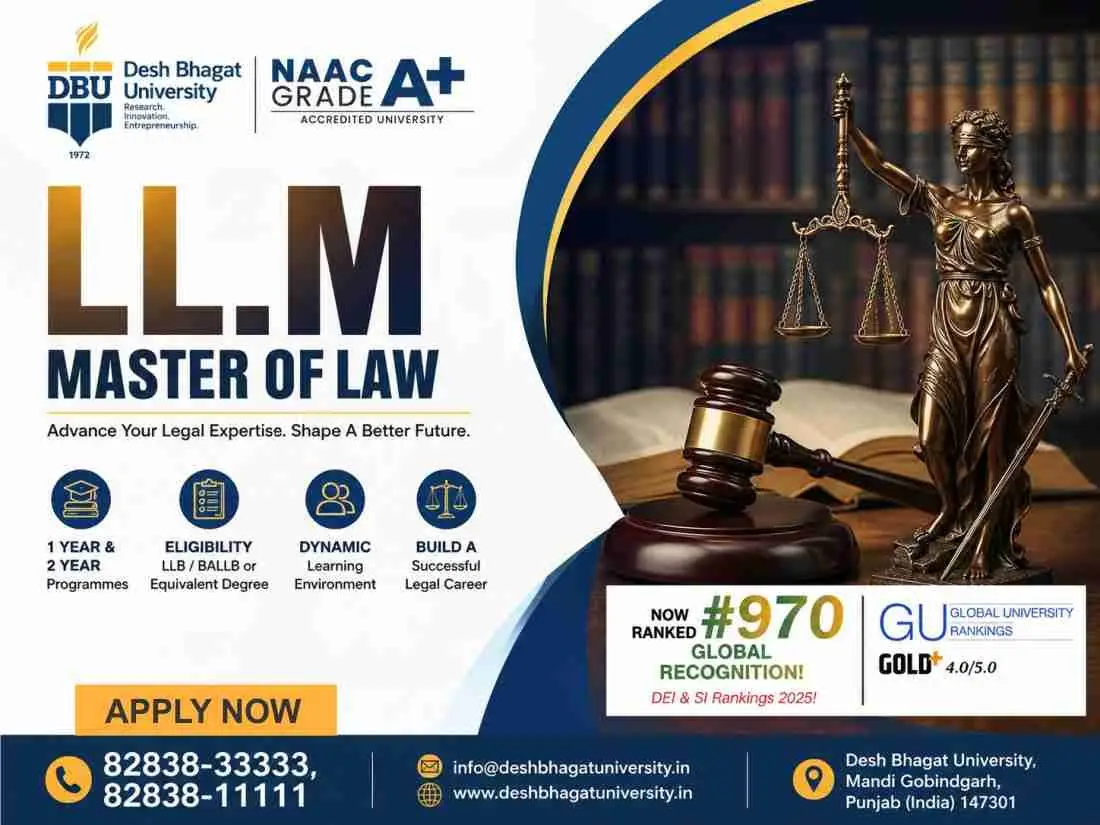
At Desh Bhagat University, students can choose between an LLM 1-year course and an LLM 2-year course. The university’s current programme information lists LLB, BALLB, and equivalent law qualifications as the eligibility route for these programmes, subject to the prescribed marks and category-based relaxation.
This guide explains the LLM course duration, eligibility, admission process, subjects, career options, and the difference between 1-year and 2-year LLM programs.
Quick Overview of LLM Course
| LLM Course Detail | Information |
| Full Form | Master of Laws |
| Course Level | Postgraduate |
| Field | Law and Legal Studies |
| Duration | 1 Year or 2 Years |
| Eligibility | LLB, BALLB or equivalent law degree |
| Study Focus | Advanced legal knowledge and specialised study |
| Main Areas | Legal research, specialised law, legal theory and practice |
| Admission | As per university admission requirements |
| Career Areas | Legal research, corporate sector, legal consultancy, academics and related fields |
What is an LLM Course?
An LLM course is a postgraduate programme in law that allows law graduates to study legal subjects at an advanced level. The programme is generally pursued after completing an LLB or an equivalent law qualification.
The degree is commonly known as LLM because of its Latin academic abbreviation, Legum Magister, meaning Master of Laws.
Unlike an undergraduate law programme, an LLM focuses more deeply on selected legal subjects, legal research, analysis, interpretation of laws, and advanced understanding of legal systems. Depending on the programme, students may study areas such as constitutional law, corporate law, criminal law, human rights law, international law, environmental law, intellectual property law, and other specialised fields.
An LLM can therefore be considered an advanced academic qualification for students who already have a background in law.
What is the LLM Full Form?
The LLM full form is Master of Laws.
It is a postgraduate academic degree in the field of legal studies. Students generally pursue an LLM after completing an LLB, BALLB, or another equivalent law qualification.
The purpose of the programme is to provide advanced knowledge and encourage students to understand legal issues through detailed study, analysis, research, and specialised learning.
Why Study an LLM Course?
Students may choose an LLM course for different academic and professional reasons. Some students want to specialise in a particular area of law, while others are interested in research, teaching, corporate legal work, policy, or advanced legal studies.
Some important reasons to pursue an LLM include:
Advanced Legal Knowledge
An LLM allows students to study legal concepts in greater depth. Students can explore complex legal issues and develop a better understanding of how laws are interpreted and applied.
Specialised Study
Law is a broad field. Students may have an interest in areas such as corporate law, criminal law, constitutional law, international law, environmental law, or human rights law. Advanced study can help students focus on areas related to their interests.
Research Skills
Legal research is an important part of advanced law education. Students can learn how to identify legal issues, examine legal sources, analyse cases, and present arguments in a structured way.
Academic Development
Students who are interested in higher education or research can use an LLM as an important postgraduate qualification before pursuing further academic opportunities.
Professional Development
An advanced law qualification may also help graduates explore roles in legal consultancy, corporate organisations, compliance, research, policy-related work, and other professional areas.
LLM Eligibility
Understanding LLM eligibility is one of the first steps before applying for the programme.
The eligibility requirements can differ between universities. Therefore, students should always check the latest programme requirements before applying.
At Desh Bhagat University, the current programme information states that candidates for the LLM programmes should have an LLB, BALLB, or an equivalent law degree from a recognised university.
LLM Course Eligibility at DBU
| Requirement | Details |
| Academic Qualification | LLB, BALLB or equivalent law qualification |
| Recognised Institution | Degree from a recognised university |
| Minimum Marks | 55% |
| Relaxation | 5% relaxation for SC/ST students |
| Programme Options | 1-Year and 2-Year LLM |
Students should verify the latest admission notification and programme information before submitting an application because eligibility rules and admission requirements can be updated.
LLM Course Eligibility: Who Can Apply?
Students who have completed an appropriate undergraduate law qualification can consider an LLM programme.
Common qualifying degrees may include:
- LLB
- BALLB
- B.Sc. LL.B
- BBA LL.B
- B.Tech. LL.B
- B.Com LL.B
- Other equivalent law qualifications recognised by the university
DBU’s programme material specifically lists LLB, BALLB and equivalent law qualifications, including integrated law degrees such as B.Sc. LL.B, BBA LL.B, B.Tech. LL.B and B.Com LL.B.
Students should check whether their particular qualification is accepted before applying.
LLM Course Duration
The LLM course duration depends on the programme selected.
At Desh Bhagat University, the LLM programme is available in two duration options:
- LLM 1 Year Course: 1 year
- LLM 2 Year Course: 2 years
The university’s programme documents list the 2-year programme as four semesters and the 1-year programme as two semesters.
The difference in duration allows eligible students to select a programme according to their academic plans and preferred study structure.
LLM 1 Year Course
The LLM 1 year course is a postgraduate law programme designed to provide advanced legal education within a shorter academic duration.
At Desh Bhagat University, the 1-year LLM programme has a duration of one year. The current DBU programme information states that candidates should have an LLB, BALLB or equivalent qualification with 55% marks, with a 5% relaxation for SC/ST students.
Key Features of LLM 1 Year Course
- Duration of one year
- Postgraduate law qualification
- Suitable for eligible law graduates
- Focus on advanced legal studies
- Two-semester structure
- Opportunities for specialised legal learning
- Emphasis on legal knowledge and research
The shorter duration can be suitable for students who want to complete their postgraduate legal studies within one academic year.
LLM 2 Year Course
The LLM 2 year course provides a longer period for postgraduate legal study.
At Desh Bhagat University, the 2-year LLM programme is structured over two years and four semesters. The current eligibility information requires LLB, BALLB or an equivalent law qualification with 55% marks, with a 5% relaxation for SC/ST students.
Key Features of LLM 2 Year Course
- Duration of two years
- Four-semester structure
- Postgraduate law qualification
- Advanced legal study
- Legal research and analytical learning
- Opportunity for deeper study over a longer period
- Suitable for eligible law graduates
The extended duration gives students more time to engage with advanced legal subjects, research, academic activities, and specialised areas of law.
LLM 1 Year Course vs LLM 2 Year Course
One of the most common questions students ask is whether they should choose an LLM 1 year course or an LLM 2 year course.
The basic difference is the duration and academic structure.
| Feature | LLM 1 Year Course | LLM 2 Year Course |
| Duration | 1 Year | 2 Years |
| Semesters | 2 | 4 |
| Degree | Master of Laws | Master of Laws |
| Academic Level | Postgraduate | Postgraduate |
| Eligibility | LLB/BALLB/equivalent | LLB/BALLB/equivalent |
| Minimum Marks at DBU | 55% | 55% |
| SC/ST Relaxation | 5% | 5% |
| Main Focus | Advanced legal study | Extended advanced legal study |
At DBU, the published eligibility for the two programmes follows the same general qualification route, while the duration differs.
Students should select the programme after considering the current university requirements, academic goals, preferred duration, and future plans.
Which is Better: LLM 1 Year or 2 Year?
There is no single option that is better for every student. The choice between an LLM 1 year course and an LLM 2 year course depends on your academic goals, preferred study duration, research interests, and future career plans.
| Comparison Factor | LLM 1 Year Course | LLM 2 Year Course |
|---|---|---|
| Course Duration | 1 year | 2 years |
| Academic Structure | Shorter and more focused | Longer and more extensive |
| Study Approach | Suitable for students seeking a shorter postgraduate programme | Suitable for students who prefer more time for advanced legal study |
| Legal Studies | Focuses on advanced legal concepts within a shorter period | Provides more time for detailed legal learning |
| Research Opportunities | Suitable for focused research activities | Provides additional time for research and academic activities |
| Subjects & Learning | Concentrated academic schedule | Extended learning schedule |
| Career Planning | Suitable for students looking to complete postgraduate study sooner | Suitable for students who want a longer period of academic development |
| Best Suited For | Students who prefer a shorter LLM programme | Students who prefer an extended postgraduate learning experience |
| Decision Factor | Choose based on your academic and career goals | Choose based on your academic and career goals |
Which should you choose?
If completing your postgraduate law education in a shorter period is your priority, an LLM 1 year course may be suitable. If you prefer a longer academic structure with more time for study and research, an LLM 2 year course may be a better fit.
LLM Course Subjects
The subjects in an LLM course may vary based on the university, programme structure, and area of specialisation. Students generally study advanced legal concepts along with research, analysis, and specialised areas of law.
| LLM Course Subject | What Students Learn |
|---|---|
| Constitutional Law | Constitution, fundamental rights, constitutional interpretation, government institutions, and the relationship between different organs of the state. |
| Criminal Law | Criminal offences, criminal responsibility, legal procedures, evidence, and principles of criminal justice. |
| Corporate Law | Companies, business organisations, corporate governance, business transactions, and regulatory requirements. |
| Human Rights Law | Human rights, freedoms, legal protections, international frameworks, and mechanisms for protecting individuals and communities. |
| International Law | Legal principles governing relationships between countries and other international entities. |
| Environmental Law | Environmental protection, natural resources, pollution control, environmental regulations, and sustainable development. |
| Intellectual Property Law | Patents, trademarks, copyrights, innovations, creative works, and protection of intellectual property rights. |
| Legal Research | Legal research methods, identifying legal issues, finding legal sources, analysing cases, interpreting legal materials, and legal writing. |
Note: The exact LLM course subjects can vary by university, programme, semester, and specialisation. Students should check the latest official curriculum of the selected LLM program before admission.
LLM Programs and Areas of Specialisation
LLM programs allow law graduates to develop advanced knowledge in specific areas of legal study. The choice of specialisation can help students focus on a particular field based on their academic interests and career goals.
| LLM Specialisation | Key Areas of Study |
|---|---|
| Constitutional Law | Constitutional principles, fundamental rights, judicial review, and governance |
| Criminal Law | Criminal offences, criminal justice, evidence, and legal procedures |
| Corporate Law | Companies, corporate governance, business transactions, and regulations |
| Human Rights Law | Human rights, freedoms, legal protections, and international frameworks |
| International Law | International legal principles, treaties, and relations between states |
| Environmental Law | Environmental protection, natural resources, pollution control, and regulations |
| Intellectual Property Law | Patents, trademarks, copyrights, and protection of intellectual creations |
| Labour Law | Employment relationships, workplace regulations, labour rights, and disputes |
| Family Law | Marriage, divorce, child-related matters, family rights, and legal disputes |
| Legal Research | Legal research methods, case analysis, legal writing, and interpretation of legal sources |
How to Choose an LLM Specialisation?
Students should consider their academic interests, career goals, preferred area of law, research interests, and the subjects offered by the university before selecting a specialisation.
The availability of specific specialisations can vary between LLM programs. Therefore, students should check the latest official curriculum and programme structure before applying for an LLM degree in law.
LLM Admission Process
| Admission Stage | Key Requirement |
|---|---|
| Eligibility Check | Meet the required academic qualifications and marks. |
| Programme Selection | Choose an LLM 1-year or 2-year course. |
| Application | Complete and submit the application form. |
| Document Submission | Submit academic and required supporting documents. |
| Entrance Requirements | Complete an entrance exam, if applicable. |
| Final Enrolment | Confirm admission and complete enrolment formalities. |
LLM Entrance Exam
An LLM entrance exam may be part of the admission process depending on the university and admission session.
Students preparing for an entrance examination should understand the prescribed syllabus and examination pattern. Preparation can include revision of core legal subjects, legal reasoning, current legal developments, constitutional principles, and other areas specified by the university.
For DBU applicants, the university has published an LLM Entrance Exam guide that provides information about the programme and eligibility.
Students should always refer to the latest official admission notice for current dates, application requirements, and examination details.
Can You Pursue LLM After LLB?
Yes, LLM after LLB is a common postgraduate study route.
Students who complete an LLB can consider an LLM to develop advanced knowledge of law and study specialised legal subjects.
For example, a student may complete an LLB and then pursue an LLM in an area related to corporate law, constitutional law, criminal law, human rights, international law, or another specialised field.
At Desh Bhagat University, the current eligibility information allows candidates with LLB, BALLB, or equivalent law qualifications to apply for the LLM programmes, subject to the prescribed marks and other requirements.
Skills Developed During an LLM Course
An LLM course can help students develop several academic and professional skills.
| Skill | How an LLM Course Helps |
|---|---|
| Legal Research | Develops the ability to find, evaluate, and use relevant legal sources. |
| Critical Thinking | Helps students examine legal issues and form logical conclusions. |
| Legal Writing | Improves skills in preparing legal arguments, research papers, and reports. |
| Analytical Skills | Strengthens the ability to analyse cases, laws, regulations, and legal principles. |
| Communication Skills | Builds professional communication through presentations, discussions, and academic work. |
| Problem-Solving | Develops the ability to identify legal problems and evaluate possible solutions. |
Career Options after an LLM Degree
An LLM can support different academic and professional pathways. Career opportunities depend on the student’s qualifications, skills, experience, applicable professional rules, and the specific role.
| Career Area | Career Opportunities after an LLM |
|---|---|
| Legal Research | Work on case analysis, legislation, legal databases, and research projects. |
| Corporate Legal Sector | Explore roles related to contracts, legal requirements, and corporate matters. |
| Legal Consultancy | Provide specialised legal knowledge and consultancy support, subject to applicable requirements. |
| Academics & Research | Pursue teaching, academic research, and further qualifications. |
| Policy & Governance | Explore opportunities in policy research, governance, and regulatory areas. |
| Compliance | Work with organisations on regulatory requirements, internal policies, and compliance. |
| Legal Content & Publishing | Explore legal writing, publishing, content development, and knowledge-based roles. |
Why Choose Desh Bhagat University for an LLM Course?
Desh Bhagat University offers LLM programmes through its legal studies academic structure. The university’s current programme information includes both LLM 1 Year and LLM 2 Year options.
The university’s law-related academic information highlights areas such as practical learning, legal activities, guest lectures, legal aid, moot court activities, court visits, internships, debates, client counselling, and access to legal learning resources.
For students considering postgraduate legal education, these activities can complement classroom learning and help them understand how legal concepts relate to practical situations.
Academic and Practical Learning in Law
Legal education involves more than reading textbooks. Students need opportunities to understand how legal concepts are applied in real situations.
Practical academic activities can include:
| Learning Activity | Skills & Learning Outcomes |
|---|---|
| Moot Court Activities | Develop legal arguments, research, and courtroom presentation skills. |
| Case Analysis | Improve understanding of judgments, legal principles, and case facts. |
| Legal Discussions & Debates | Strengthen communication, reasoning, and critical thinking skills. |
| Presentations | Build confidence and professional presentation skills. |
| Court Visits | Provide practical exposure to court procedures and legal proceedings. |
| Legal Aid Activities | Develop an understanding of legal services and practical legal issues. |
| Guest Lectures | Gain insights into current legal practices and professional perspectives. |
| Research Work | Improve legal research, analysis, and academic writing skills. |
| Client Counselling | Develop communication and problem-solving skills in simulated legal situations. |
Such activities can help students develop communication, analytical, research, and presentation skills alongside academic knowledge.
How to Choose the Right LLM Program?
Before selecting an LLM programme, students should consider several factors.
| Factor | What to Consider When Choosing an LLM Programme |
|---|---|
| Eligibility | Check the required law qualification, minimum marks, and other eligibility criteria. |
| Course Duration | Compare the LLM 1-year course and LLM 2-year course based on your academic plans. |
| Curriculum | Review the subjects and specialisations offered by the programme. |
| Admission Process | Check entrance exam requirements, application procedures, documents, and admission dates. |
| Career Goals | Choose a programme that aligns with your interests in research, academics, corporate law, policy, or compliance. |
| University Information | Refer to the latest official university information for updated eligibility, fees, curriculum, and admission details. |
LLM Course vs LLB
LLB and LLM are different levels of legal education.
| Feature | LLB | LLM |
| Full Form | Bachelor of Laws | Master of Laws |
| Level | Undergraduate/Professional Law Degree | Postgraduate Law Degree |
| Purpose | Foundation and professional legal education | Advanced legal study |
| Entry Route | Depends on programme | Usually after a law degree |
| Duration | Varies by programme | 1 or 2 years at DBU |
| Focus | Core legal education | Advanced and specialised legal study |
An LLB generally provides the foundational legal education required before pursuing advanced postgraduate law studies. An LLM builds on that legal background.
Is an LLM Course Useful After LLB?
An LLM can be useful for students who want to develop advanced knowledge in a particular area of law.
However, the value of an LLM depends on the student’s goals.
For a student interested in academic research, advanced legal knowledge, specialised study, corporate legal roles, policy, or compliance, postgraduate legal education may be relevant.
Students should therefore choose an LLM based on their career objectives rather than pursuing the degree only because it is a higher qualification.
Documents Required for LLM Admission
The exact document list can vary depending on the admission process. Students should check the latest official instructions.
Common documents may include:
| Document | Purpose / Requirement |
|---|---|
| LLB or Equivalent Degree Certificate | Proof of the required law qualification. |
| Academic Marksheets | Verification of academic performance and eligibility. |
| Identity Proof | Verification of the candidate’s identity. |
| Passport-Size Photographs | Used for application and admission records. |
| Category Certificate | Required where applicable for category-based benefits. |
| Migration/Transfer Certificate | Submitted when required by the university. |
| Other Required Documents | Any additional documents specified during admission. |
Candidates should keep clear copies of their academic documents ready before starting the application process.
LLM Course: Important Points to Remember
Before applying for an LLM course, students should remember these important points:
- LLM stands for Master of Laws.
- It is a postgraduate programme in legal studies.
- LLM is generally pursued after completing a qualifying law degree.
- DBU offers both 1-year and 2-year LLM programmes.
- DBU’s current programme information lists LLB, BALLB, or equivalent law qualifications for LLM admission.
- The current DBU programme information specifies 55% marks with a 5% relaxation for SC/ST students.
- The LLM course duration depends on the selected programme.
- The 1-year programme has a shorter academic structure.
- The 2-year programme provides a longer period of postgraduate study.
- Students should check the latest official admission information before applying.
Conclusion
An LLM course is a postgraduate programme for students who want to develop advanced knowledge of law after completing a qualifying law degree. The programme can provide opportunities to study legal subjects in greater depth and explore specialised areas of legal education.
The LLM course duration depends on the programme. At Desh Bhagat University, students can choose between an LLM 1-year course and an LLM 2-year course. The current DBU eligibility information states that candidates with LLB, BALLB, or equivalent law qualifications can apply, subject to the prescribed marks and applicable relaxation.
Students considering LLM after LLB should compare the programme duration, eligibility, subjects, admission process, academic structure, and future career objectives before making a decision.
For students interested in an LLM degree in law, the right programme should provide a strong academic foundation, opportunities for legal research, specialised learning, and exposure to different aspects of legal education.
Frequently Asked Questions
An LLM course is a postgraduate law programme that provides advanced study of legal subjects and specialised areas of law. It is generally pursued after completing an LLB or an equivalent law qualification.
The LLM full form is Master of Laws. It is a postgraduate academic degree in the field of legal studies.
LLM eligibility varies by university. At Desh Bhagat University, the current programme information lists LLB, BALLB, or an equivalent law qualification with 55% marks, with a 5% relaxation for SC/ST students.
For the current DBU LLM programmes, candidates should have an LLB, BALLB, or equivalent law degree from a recognised university with the prescribed marks. DBU’s current programme material specifies 55% marks and a 5% relaxation for SC/ST students.
An LLM can be offered as either a 1-year or 2-year programme, depending on the university. Desh Bhagat University currently lists both LLM 1-year and LLM 2-year programmes.
An LLM 1 year course is a postgraduate Master of Laws programme completed over one year. At DBU, the 1-year programme is structured over two semesters.
An LLM 2 year course is a postgraduate Master of Laws programme completed over two years. At DBU, the programme is structured over four semesters.
The main difference is the duration and academic structure. The LLM 1 year course is completed in one year, while the LLM 2 year course is completed in two years. DBU’s current information lists both programmes with the same general law-degree eligibility route.
Yes. LLM after LLB is a common postgraduate study pathway. Students who have completed an eligible LLB or equivalent law qualification can apply for an LLM subject to the university’s eligibility requirements.
The LLM course duration at DBU is either one year or two years, depending on the selected programme. The 1-year LLM has two semesters, while the 2-year LLM has four semesters.
LLM subjects can vary by programme and university. Common areas include constitutional law, criminal law, corporate law, human rights law, international law, environmental law, intellectual property law, and legal research.
LLM graduates can explore areas such as legal research, corporate legal work, compliance, legal consultancy, policy-related work, academic research, teaching, legal publishing, and other law-related fields, depending on their qualifications and applicable professional requirements.
An LLM degree in law can be useful for students who want advanced legal knowledge, specialised study, research experience, or academic development. Its usefulness depends on the student’s career goals and the area of law they choose to study.
For LLM admission, students should first check the latest eligibility criteria, select the appropriate programme, complete the application, submit the required documents, and follow any entrance examination or selection requirements specified by the university.
The choice depends on your academic goals and preferred duration. The 1-year programme provides a shorter postgraduate study route, while the 2-year programme provides a longer academic structure. Students should compare the current curriculum, eligibility, duration, and admission requirements before choosing.