BAMS vs BDS: Which Course is Better?
December 15, 2025 2025-12-15 7:09BAMS vs BDS: Which Course is Better?
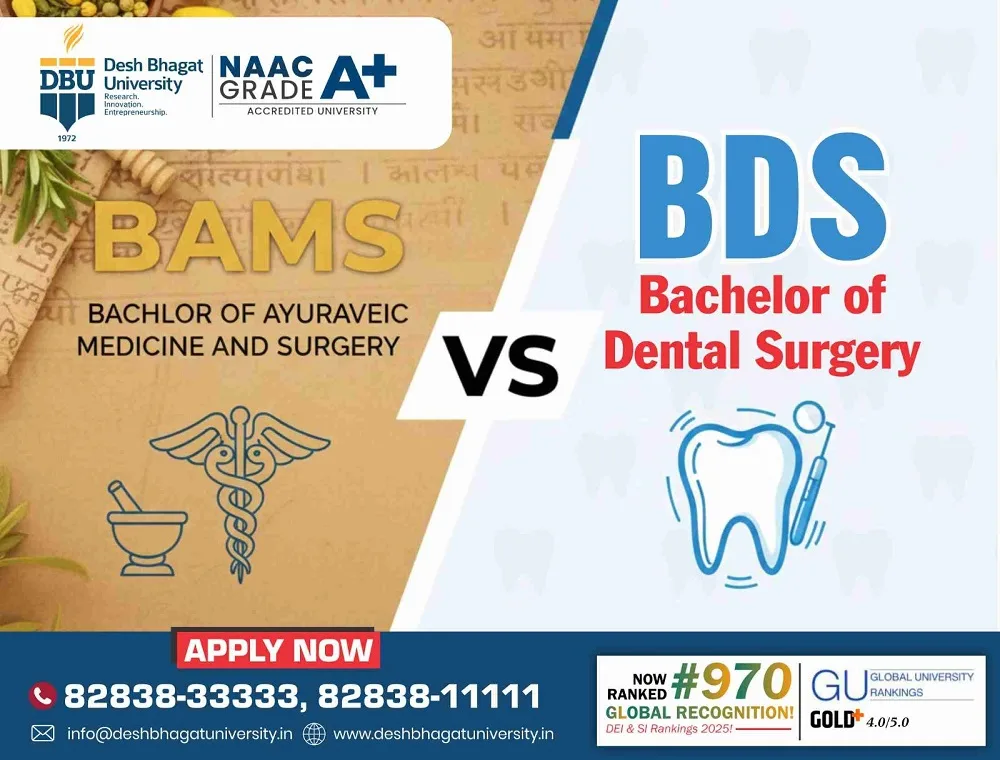
BAMS vs BDS: Which Course is Better?
At Desh Bhagat University, we understand that choosing the right professional course after class 12 is one of the most important decisions for students. Today, many students and parents ask us: “BAMS vs BDS, which is better?” “What is the difference between BAMS vs BDS?”, “Which course has more scope?”, and “What about the salary?” In this detailed but easy-to-understand article, we will explain everything you need to know about BAMS and BDS from a student’s perspective at Desh Bhagat University.
What Are BAMS and BDS?
Before we compare both courses, it is important to understand what they mean.
BAMS (Bachelor of Ayurvedic Medicine and Surgery) is an undergraduate medical degree focused on Ayurveda, the traditional Indian system of medicine. This course prepares students to become Ayurvedic doctors who treat diseases using holistic and natural treatment methods. At Desh Bhagat University, BAMS is a 5.5-year program that includes both classroom teaching and practical clinical experience with a one-year compulsory internship.
BDS (Bachelor of Dental Surgery) is an undergraduate degree in dentistry. Students who complete BDS become dental surgeons with the skills to diagnose and treat diseases of teeth, gums, and oral tissues. This course is typically five years long, including practical training.
Duration and Structure
The duration and course structure are important factors when comparing BAMS vs BDS.
BAMS at Desh Bhagat University
- Duration: 5 Years and 6 Months (4.5 years academic study + 1 year internship).
- Internship included gaining real-world Ayurvedic clinical experience.
- Focus: Ayurvedic medicines, Panchakarma, traditional healing methods, and diagnosis through constitutional study.
BDS at Desh Bhagat University
- Duration: 5 Years (typically without a separate internship year outside the clinical training during the course).
- Focus: Oral health, teeth structure, dental surgery, orthodontics, preventive dentistry.
Both degrees are full-time and require students to complete rigorous academic as well as clinical training.
Admission Requirements
At Desh Bhagat University, admission to both BAMS and BDS programs requires specific eligibility criteria:
BAMS Admission
- Students must have passed class 12 with Physics, Chemistry & Biology.
- A valid NEET score is needed for AYUSH stream admissions, including BAMS.
BDS Admission
- Admission to the dental program (BDS) also requires passing class 12 with PCB.
- A valid NEET score is essential for admission into the BDS course.
NEET performance plays a significant role as it determines eligibility, ranking, and counselling for seats in medical and allied streams.
Curriculum and Learning Focus
Understanding the curriculum helps students decide which path suits their interests.
BAMS Curriculum
The BAMS curriculum integrates traditional Ayurvedic knowledge with modern scientific understanding of health. Students study subjects such as:
- Sanskrit and ancient Ayurveda texts
- Dravyaguna (Ayurvedic drug science)
- Panchakarma therapy
- Rachana Sharir and Kriya Sharir (Ayurvedic anatomy and physiology)
- Clinical training in Ayurvedic diagnosis and patient management.
The training focuses on preventive healthcare, natural remedies, and personalized treatment.
BDS Curriculum
In BDS, the focus is on dental and oral health. Students learn:
- Dental anatomy and pathology
- Oral surgery and prosthodontics
- Orthodontics
- Periodontology and conservative dentistry
- Clinical patient care in dental settings.
The BDS curriculum ensures students gain expertise in clinical procedures and dental health interventions.
BAMS vs BDS: Which Is Better?
When we address BAMS vs BDS, which is better, the answer depends on your interests and career goals. Each course has its own strengths.
Why Choose BAMS?
- Ideal for students passionate about holistic and traditional medicine.
- Focus on preventive, holistic healing grounded in Ayurvedic principles.
- Opportunity to work in growing areas like herbal products, wellness centres, Ayurvedic clinics, and research.
- A strong foundation in herbal medicines and natural therapies.
Why Choose BDS?
- Best choice for students interested in oral health and dental surgery.
- Clinical focus makes it suitable for becoming a practising dentist.
- BDS graduates can specialize in areas like orthodontics, oral surgery, and prosthodontics.
- Opportunities in private dental clinics, hospitals, academics, and dental research.
There is no single answer to “which is better”. It really depends on what field excites you more — Ayurvedic medicine and wellness or dental science and oral surgery.
Career Scope: BAMS vs BDS Scope
One of the key concerns for students is scope after graduation.
Scope after BAMS
Graduates of BAMS from Desh Bhagat University can pursue careers in several areas:
- Ayurvedic physician in hospitals and clinics
- Ayurvedic researcher or academician
- Consultant at wellness and lifestyle centres
- Entrepreneur in Ayurvedic products, herbal medicine manufacturing
- Roles in government health departments or AYUSH organisations
The demand for traditional and preventive medicine is growing around the world. Many people now prefer natural and holistic ways to stay healthy. Because of this, BAMS has more career opportunities. Students can work in clinics as well as in wellness and healthcare centers, making the scope of BAMS wider and stronger.
Scope after BDS
After completing BDS, students have a broad range of career pathways:
- Private dental practice
- Dental surgeon in hospitals or health centres
- Specialization in advanced dental fields (MDS)
- Teaching and research roles in dental colleges
- Dental consultant or therapy specialist
Oral health is considered essential healthcare everywhere. The growing awareness of dental hygiene and cosmetic dentistry continues to expand opportunities for BDS graduates.
Salary Comparison: BAMS vs BDS Salary
Students and parents often ask, “Which course gives a better salary — BAMS or BDS?”
Salary Comparison Table: BAMS vs BDS Salary (India)
| Career Stage / Job Type | BAMS Salary (Typical Range) | BDS Salary (Typical Range) |
| Fresher (Private Clinic / Hospital) | ₹20,000 – ₹50,000 per month | ₹25,000 – ₹50,000 per month |
| Government Job (Medical Officer / Dental Officer – Base Pay Example) | Basic pay around ₹47,600 per month (plus allowances) | Varies by state and post; government roles generally offer stable pay + benefits |
| Experienced (5+ years, strong practice/role) | Around ₹30,000 – ₹1,00,000+ per month (depends on clinic and reputation) | Wider range; increases strongly with experience and patient flow |
| After Specialization (Example: Orthodontist) | Not applicable in the same way (income depends more on role and practice) | Average around ₹49,625 per month (reported average) |
Note: Salary is not fixed. A student can earn more if they build strong skills, choose the right location, and grow their practice over time.
Long-Term Benefits of Choosing Any Course at DBU
At Desh Bhagat University, we focus on more than just degree completion. Our students benefit from:
- Mentorship by experienced faculty
- Hands-on clinical and practical training
- Support in career planning and internships
- Exposure to the latest healthcare practices
Our environment supports growth in both traditional Ayurvedic practice and modern dental sciences.
Final Thoughts: Choosing Your Path
Choosing between BAMS vs BDS should be based on your interests, career goals, and the kind of work you see yourself doing every day.
Ask yourself:
- Do I enjoy learning about natural and traditional medicine?
- Am I interested in oral healthcare and surgery?
- Do I want to work in a clinic, operate independently, or specialize in research?
There is no right or wrong answer — only the right fit for you.
At Desh Bhagat University, both BAMS and BDS programs are designed to help you succeed in your chosen field. We encourage you to explore both courses in detail, visit our campus if possible, and speak with faculty or counsellors before making your choice.
Conclusion
In conclusion, BAMS vs BDS is not a competition but a comparison of two different professional journeys. Both fields offer successful careers and meaningful contributions to healthcare.
BAMS is perfect for those passionate about Ayurvedic and holistic health. On the other hand, BDS is suitable for students who want to build a career in dental medicine and take care of teeth and oral health.
At Desh Bhagat University, we are committed to guiding students to make informed decisions that align with their aspirations and help them build a successful future in either path.
We hope this article has clearly answered BAMS vs BDS, which is better, explained the BAMS vs BDS scope, and shared clear information about BAMS vs BDS salary. If you want to know more about admissions, eligibility, or course details, visit the Desh Bhagat University official website.
FAQs
1. What is the main difference between BAMS and BDS?
At Desh Bhagat University, we explain that the main difference between BAMS and BDS is the type of medical system they follow. BAMS is based on Ayurveda, which is an ancient Indian system of medicine using natural treatments and herbs. BDS is based on modern dental science and focuses on teeth, gums, and oral health. Both are medical careers, but in different fields.
2. BAMS vs BDS: Which is better for students after 12th?
BAMS vs BDS, which is better, depends on the student’s interest. At Desh Bhagat University, we believe BAMS is better for students who like natural healing and holistic medicine. BDS is better for students who want to become dentists and work on oral health. Both courses are good career options and offer professional respect and growth.
3. What is the eligibility for BAMS and BDS at Desh Bhagat University?
For both BAMS and BDS at Desh Bhagat University, students must pass Class 12 with Physics, Chemistry, and Biology. A valid NEET score is required for admission. Students must meet the minimum marks criteria as per government guidelines. We guide students properly during admission so they understand every step clearly.
4. What is the duration of BAMS and BDS courses?
At Desh Bhagat University, the BAMS course duration is 5.5 years, which includes 4.5 years of academic study and 1 year of compulsory internship. The BDS course duration is 5 years, which includes both theory and clinical training. Both courses require full-time study and dedication to medical education.
5. What is the career scope after BAMS?
The BAMS scope is growing fast. At Desh Bhagat University, BAMS graduates can work as Ayurvedic doctors, consultants, researchers, teachers, or wellness experts. They can also start their own Ayurvedic clinics or work in hospitals and wellness centers. The demand for Ayurvedic and natural treatments is increasing in India and globally.
6. What is the career scope after BDS?
The BDS scope is strong and stable. After completing BDS from Desh Bhagat University, students can work as dentists in private clinics, hospitals, or dental colleges. They can also go for higher studies like MDS. Dental health is always important, so career opportunities continue to grow in this field.
7. What is the salary after BAMS?
The BAMS salary depends on experience, skills, and place of work. At Desh Bhagat University, we see that fresh BAMS graduates usually start with moderate salaries in clinics or hospitals. With experience, income increases. Those who open their own clinics or work in wellness centers and research fields can earn good income over time.
8. What is the salary after BDS?
The BDS salary is generally higher at the beginning compared to many other medical courses. At Desh Bhagat University, BDS graduates can earn good salaries in private clinics and hospitals. With experience and specialization, dentists can earn a very high income. Earnings also depend on the number of patients and the practice location.
9. Is NEET compulsory for BAMS and BDS admission?
Yes, NEET is compulsory for both BAMS and BDS admission at Desh Bhagat University. NEET helps ensure fair selection and standard medical education. Students must qualify for NEET to be eligible for counselling and admission. We help students understand NEET requirements and support them throughout the admission process.
10. Why should students choose Desh Bhagat University for BAMS or BDS?
At Desh Bhagat University, we provide quality education, experienced faculty, practical training, and career guidance. Our focus is on building strong medical professionals with both knowledge and skills. We offer a supportive learning environment, modern facilities, and hands-on clinical exposure, helping students build a successful career in BAMS or BDS.